Posts

Showing posts with the label tropical fruit

Jackfruit

Image
Jackfruit ( Artocarpus heterophyllus ), a native plant of India, is a common fruit tree in Southeast Asia where it fruits all year round--in contrast to other local fruit trees like rambutan and mangosteen that produce fruit seasonally. The fruit bears some resemblance to the durian , but it has shorter spikes and the barrel-shaped fruit is among the largest tropical fruit, reaching up to 20 inch across. Jackfruit ( Artocarpus heterophyllus ) Similar to its close relative of the same family, the fig tree, jackfruit is cauliflorous, bearing flowers and fruits on the trunk and main branches. It has a dense and neat crown with thick and dark glossy-green leaves, rendering itself a suitable garden plant, too. Jackfruit is easily propagated from seed, growing up to 60 feet tall and start producing fruit after about three years. Jackfruits contain starch, minerals and vitamins. The fruit of this wind pollinated tree contains numerous seeds, each about 1.5 inch long and c...
Mango Fruit Tree

Image
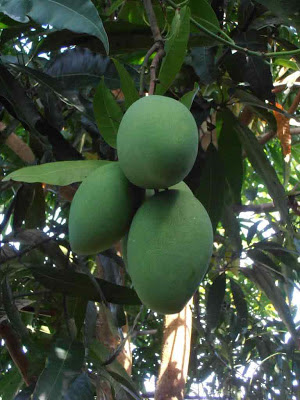
One of the oldest known fruit trees cultivated by man, the mango tree ( Mangifera indica ) originated from India and Southeast Asia, where it has been planted for over 4000 years mainly for its fruit. Crossings between various individual trees have produce hundreds if not thousands of mango cultivars. Each mango cultivar has its own smell, taste, size and time of maturity, among other characteristics.  Mango fruit In Thailand, cultivars are classified as either that that is eaten ripe or unripe. The former includes   Rad , and the latter includes Okrong which is very sweet, juicy and greenish-yellow in colour. In India, one of the most popular mango cultivars is the Neelam , a highly fragrant cultivar with high keeping quality and yellow saffron coloured fruit. The mango tree itself is beautiful making it suitable for gardens. The crown is more or less rounded, and the alternately arranged dark green leaves are crowded toward the tip. Young leaves, however, is r...

Mangosteen Tree and Fruit

Image
Ripe Mangosteen fruits ready to serve. The Mangosteen, like the Durian and Rambutan, has its origin in Southeast Asia. Mangosteen fruit is round and crowned with several woody lobes. The rind of a ripe fruit is dark purple. It is rather thick, but soft. If you squeeze lightly each side of the fruit, it would split open, revealing segments of white flesh covering some seeds arranged in a circle. The taste of Mangosteen fruit is sweet but acidic. Mangosteen trees Botanically, the Mangosteen ( Garcinia mangostana ) belongs to the family Guttiferae, and the genus Garcinia in particular consist of hundreds of species found in the tropics. It is a small tree with oppositely arranged thick, dark green leaves. It is not an easy task to grow the Mangosteen tree in large scale for it may takes up to 15 years before fruiting began. Related Post Hairy Rambutan Fruit

Hairy Rambutan Fruit

Image
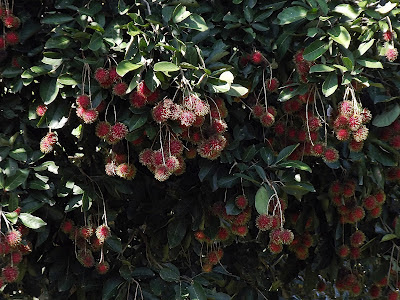
Bunches of ripe Rambutan fruits Rambutan trees ( Nephelium lappaceum ) are common sight in rural areas in the region as they are grown in orchards and gardens. The Rambutan tree can reach up to 10 m in height. They are planted primarily for the fruit, easily identified by its ellipsoid shape, red colour and characteristically hairy appearance. The name Rambutan is derived from the word rambut which means hair in the Indo-Malayan region in particular. In Vietnam, however, it is known as Hairy Cherry. The outer skin is thin can be readily peel off by hands, and it encloses the white pulp that surrounds the woody seed. It is this pulp with its juicy and sweet taste that is consumed. In terms of nutrition, Rambutan fruit rich in vitamin C. There are many varieties of Rambutan, the most favourable are the ones with the pulp does not adheres to the seed so tightly. Seedless varieties also existed but they are not common. 

Carica papaya

Image
Most of us are familiar with the Papaya fruit, the cylindrical, yellow-orange tropical fruit that has a juicy and sweet orange pulp. However, many do not know that its place of origin is in South America. A papaya tree bearing unripe and partially ripe fruits Before the 16th century, papaya was virtually unknown in other parts of the world. It was the European, who discovered this fruit in the Caribbean and they gave it the same name as the locals call them - Papaya. This fruit is also referred as pawpaw, but this term was reported to be more often used in Australia and New Zealand. Closer inspection of the papaya plant ( Carica papaya ) shows that it is indeed very peculiar. For one thing, it is primarily an unbranched plant. The papaya leaves are borned at the tip of the plant, and old leaves would fall off leaving behind permanent scars that marked the trunk. The lobed leaves themselves are very distinct, with each lobe further lobed. 

Durian Fruit

Image
Durian, the king of fruit Durian fruits is one of the most popular Asian fruits especially in South-east Asia to the extent that it is regarded as the king of fruits. Locals like the the taste, smell and texture of Durians. On the contrary, many westerners in particular dislike the smell of Durians. The unmistakable capsular fruit of Durian ( Durio zibethinus ) is green and spiky, and when it is opened it reveals the seeds which are covered with yellow pulp. The pulp is usually eaten raw or cook to make porridge, for example. A full grown Durian tree. Like many tropical fruits of Asia, Durians originated from the rainforest and has been cultivated by man for a very long time. It is not unusual to find a Durian tree inside the rainforest whereby it can be identified by its conical crown and greyish-green leaves.

Cat's Eye Fruit

Image
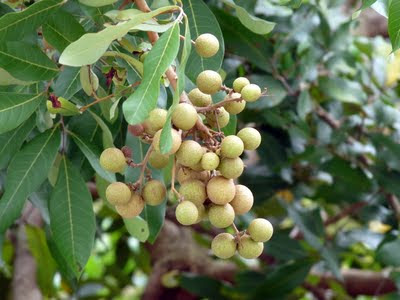
A bunch of Cat's Eye fruits The Cat's Eye fruit is  one of the most popular fruits in Southeast Asia. It is related to the Longan or Dragon's Eye ( Dimocarpus longan ). Taxonomically it is a variety  of the Longan. The scientific name of Cat's Eye plant is Dimocarpus longan var malesianus , but this particular variety is widely grown only in Southeast Asia. The small fruit contain a shiny black and smooth seed, surrounded by translucent pulp. It tastes sweet, and slightly juicy. The inflorescence of Cat's Eye fruit tree The tree itself is quite attractive with light brown bark, dark-green pinnate leaves and small, white flowers held in terminal panicles. The flower is visited by numerous flies and butterflies. It then become the fruit which is covered by thin brown and somewhat woody skin that can be easily peel off by hand. Not only people like the fruits, but many kind of animal such as treeshrew and squirrels too.

Labels

tropical fruit fruit hemiptera invasive species lizard spider Agamids animal camouflage arachnid butterfly camouflage mammals nest traditional medicine Lepidoptera adaptation antenna cuckoo insect camouflage insect mouthparts insect parts migrant birds moth poisonous plant predator reptile pictures snakes Cattle Egret Melastomataceae ants asssassin bug bird behaviour bird nest biting mouthparts cicada damselfly doves draco lizard egret flying dragon fungi ginger gliding lizards grasshopper heron hymenoptera insect adaptation invasive trees mangrove forest mangroves otter parasitoid proboscis rainforest plants shrike simple eyes sucking mouthparts vivipary wasp waterbird African Tulip Tree Ardea purpurea Asian fruits Asplenium Baya Weaver Beehive Ginger Bird's Nest Fern Black Bat Flower Black-naped Oriole Blattodea Bougainvillea Brown Shrike Butorides striatus Calotes versicolor Carica papaya Cat's Eye Fruit Cat's Whiskers Catclaw Mimosa Ceasarweed Centropus sinensis Cinnamon Bittern Clidemia hirta Colubridae Common Myna Congo Jute Coral swirl Dicranopteris linearis Dilleneaceae Dillenia Diptera Dollarbird Durians Durio zibethinus Dusky Langur Dusky Leaf Monkey Egretta garzetta Eurylaimidae Ficus Formicidae Garcinia mangostana Giant False Sensitive Mimosa Green Crested Lizard Ground Orchids Halcyon smyrnensis Hesperiidae Indian Rhododendron Indian mulberry Javan Myna Koster's Curse Lanius Lantana camara Little Egret Little Heron Macaranga tree Madagascar periwinkle Melastoma malabathricum Mimosa diplotricha Mimosa invisa Mimosa pigra Mimosa pudica Morinda citrifolia Nephelium lappaceum Odonates Oecophylla Orchidae Oriental Roller Plantain Squirrel Plumed Egret Pterophoridae Rafflesia Rambutan Rambutan tree Rosy periwinkle Rubiaceae Sensitive Plant Shrubby Simpoh Spathodea campanulata Spathoglottis plicata Stachytarpheta Striped Bronzeback Tacca chantrieri Urena lobata Varanus Water Hyacinth White-breasted Kingfisher White-breasted Waterhen White-throated Kingfisher Zingiber amphibians aphids aquatic plant banana flower banana musa barbet barn swallow bee bee flowers behaviour bird call bird foraging bird pollinated flowers bittern broadbills bufonidae bug bulbul bulbul pictures butcher bird castor bean castor oil caterpillar cauliflorous cauliflory chemoreception clavate antenna cockroach colubrid compound eyes costus speciosus crab spider crane fly cricket crow pheasant crypsis detrivore dove call dove song dragonfly ecdysis egret or heron epiphyte essential oil etlingera exoskeleton of an insect falconet fern fern plant ferns fiddler crab figs firefly fishtail palm flowerpecker fly frog gardening gastropod gerridae ginger flower greater coucal harvestmen hibiscus horticulture huntsman spider hydrophyte image of birds incomplete metamorphosis insect growth insect life cycle insect nymph insect vision introduced species jackfruit jacobson's organ jumping spider katydid kingfisher ladybug lampyridae langur larvae leafbird leafhopper leguminosae lilac long-tailed shrike longan lynx spider macaque malkoha malvaceae mango mango cultivars mangosteen mangrove ecosystem mangrove trees meliponines millipede mimicry molting molting lizard monitor lizard moulting process mudskipper mushroom mutualism nectar nephila non-venomous snake noni nonnative alien species nonnative species nonvenomous snakes nursery web spider nymph ocelli ommatidia orb weaver orb weaving spider orchid oriole orthoptera ovipositor painted bronzeback palms papaya papaya fruit parasitic plant passiflora passion flower passion vine pawpaw pectinate antenna pest pest birds pet birds pigeons pioneer species plant fiber plume pollination pollinators porterweed praying mantis preening primate prinia puddling pycnonotus rails rainforest lizard ranidae raptor red-tailed rat snake reduviidae resin robber fly root shrubs skinks skipper snail snakeweed spider web spores squirrel suboscines succession sunning symbiotic relationship tiger shrike toad tortoise beetle tree snake treehopper tropical rainforest urban birds venomous snake vipers water strider weaver ants weaver bird white white egrets wings wolf spider zingiberaceae zygodactyl feet
Show more