Posts

Showing posts with the label invasive species

Poisonous Plant: Lantana camara
Image
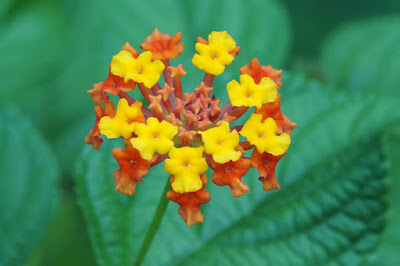
Flowers of Lantana camara . Originally brought from South America to this region for decorative purposes, Lantana camara has escaped into the wild where it thrived at clearings around villages, cultivation and forested areas. Owing to its toxicity, this shrubby plant belonging to the verbena family has become a cause of concern to the extent that it is categorized as an invasive species in some countries. Some ripe and unripe fruits of Lantana camara . The fruits, for instance, although appear edible, can cause serious implication if consumed. Indeed, fatal cases have been recorded especially among children. Ingestion of the leaves by ruminants such as cows and goats will lead to liver damage followed by death in a few days. Arrangement of leaves and flower clusters of Lantana camara . The unmistakable flower clusters are held on erect stalk from the leaf axil near the top. Most of the flowers are orange and yellow, but variations occur in which the flowers ...
Invasive Giant False Sensitive Mimosa

Image
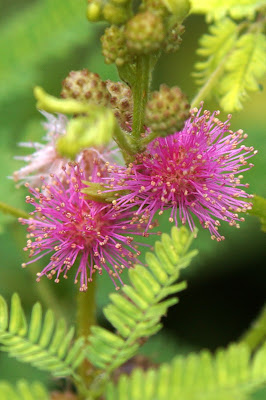
Giant False Sensitive Mimosa ( Mimosa diplotricha ) shares many features of its close relatives M. pudica . These legume has bipinnate leaves, composing of many leaflet which are sensitive to touch. What seems to be a single flower is actually numerous flowers held on a single head. Each of those tiny flower has long stamens forming a fluffy structure. A native plant of South America, Giant False Sensitive Mimosa has dispersed far and wide not only in Southeast Asia, but also in Polynesia and Taiwan. Flowers of Giant False Sensitive Mimosa. Their successful colonisation in the tropics is partly due to its fruit which readily float on water, along with the fruit's spiky outer skin which easily attaches to animals and human as well. The seeds also germinate fast in the right habitat where there is a lot of sunlight, and if condition is unsuitable, they can also lay dormant for years before germinating. Sprawling growth of Giant False Sensitive Mimosa. They are c...

African Tulip Tree

Image
Although its name suggests that it is a member of the Tulip family (Liliaceae), the fact is the African Tulip Tree ( Spathodea campanulata ) is classified into the Bignoniaceae family. Also known as the Fountain Tree, it is a fast growing, evergreen tree whose origin is in the tropical African rainforest. Mature trees can reach up to 30m and grow buttresses at the base.  African Tulip Tree flowers and unripe pods The African Tulip Tree has been introduced in many part of the tropical region because of its horticultural value. It makes a good shade tree, and it will produce spectacular orange or yellow flowers. Because the flowers are borne on the terminal branches, so naturally one can only fully appreciates their beauty when the plant is still small or when looking down from a high rise building. Like so many non-native species, the African Tulip Tree can be detrimental to the natural environment. In Hawaii, it is an invasive tree species and listed as one of the most ...

Urena lobata

Image
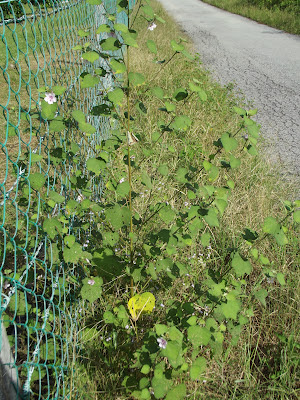
Urena lobata or Ceasarweed is one of the common shrubs growing in disturbed areas and it can reach more than 1.5m tall. The flower is attractive - pink with five petals and borne on the leaf axil. It looks like tiny hibiscus flower, and indeed it belongs to the same family as the Hibiscus, Malvaceae. The fruit is spiky and easily adheres to human trousers or presumably animal fur as well.  The leaves are palmately lobed and hairy. Urena lobata growing along rural roadside Urena lobata is also referred as the Congo Jute, because its fiber is similar in quality to that of the Jute. For this reason it is planted in Congo and some countries in South America and Asia where the fiber is made into rope and paper. Apart from being a source of fiber, the Congo Jute/Ceasar weed has many uses in traditional medicine. The leaf is known to be used as pain killers and to treat dirrhoea. The bark is beneficial to treat skin injuries and the plant is also used to treat swellings. ...

Mimosa pigra: A Notorious Invasive Tree

Image
Mimosa pigra growing in river bank Mimosa pigra or also known as Catclaw Mimosa is a widespread non-native invasive species that grows gregariously in many parts of the tropics. This invasive tree native habitat is in South America, but have since spread to other topical areas. Indeed Mimosa pigra is a notorious foreign tree that  is very difficult to control as it is easily dispersed via its hardy seeds that can survive for many years. Mimosa pigra also grows rapidly especially in sandy soil besides large rivers. As a result, local ecosystem would be altered and the relatively  rich native vegetation would become a homogenous stand of only several species of trees, and in turn some local animals like birds have to leave because of decline in fruiting trees or nesting site. Mimosa pigra flowers Mimosa pigra tree bears some resemblance to its close relative the Mimosa pudica or the Sensitive Plant, but it is much larger in size. It is a thorny plant that can gr...

Clidemia hirta (Koster's Curse)

Image
The white flowers of Clidemia hirta Clidemia hirta or also known as Koster's Curse is a locally widespread invasive species that originated from the Central and South Americas. A number of factors contributed to its successful dispersion. For example, the fruits of Clidemia hirta contain numerous tiny seeds and they are produced throughout the year; it also has broad habitat preference from edges of the rainforest to plantations. Besides that, there are many dispersal agents which feed on its fruits and then disperse the seeds including birds such as bulbuls and flowerpeckers. Ripe fruits of Clidemia hirta Clidemia hirta usually grows not more than 2 meters tall. It is a hairy shrub - the stems, leaves and fruits are covered with fine hairs. Like many members of the Melastomataceae family, the leaves are opposite in arrangement, and the veins arise from the base of the leaves, running parallel with each other toward the apex. The white flowers, with five pe...

Labels

tropical fruit fruit hemiptera invasive species lizard spider Agamids animal camouflage arachnid butterfly camouflage mammals nest traditional medicine Lepidoptera adaptation antenna cuckoo insect camouflage insect mouthparts insect parts migrant birds moth poisonous plant predator reptile pictures snakes Cattle Egret Melastomataceae ants asssassin bug bird behaviour bird nest biting mouthparts cicada damselfly doves draco lizard egret flying dragon fungi ginger gliding lizards grasshopper heron hymenoptera insect adaptation invasive trees mangrove forest mangroves otter parasitoid proboscis rainforest plants shrike simple eyes sucking mouthparts vivipary wasp waterbird African Tulip Tree Ardea purpurea Asian fruits Asplenium Baya Weaver Beehive Ginger Bird's Nest Fern Black Bat Flower Black-naped Oriole Blattodea Bougainvillea Brown Shrike Butorides striatus Calotes versicolor Carica papaya Cat's Eye Fruit Cat's Whiskers Catclaw Mimosa Ceasarweed Centropus sinensis Cinnamon Bittern Clidemia hirta Colubridae Common Myna Congo Jute Coral swirl Dicranopteris linearis Dilleneaceae Dillenia Diptera Dollarbird Durians Durio zibethinus Dusky Langur Dusky Leaf Monkey Egretta garzetta Eurylaimidae Ficus Formicidae Garcinia mangostana Giant False Sensitive Mimosa Green Crested Lizard Ground Orchids Halcyon smyrnensis Hesperiidae Indian Rhododendron Indian mulberry Javan Myna Koster's Curse Lanius Lantana camara Little Egret Little Heron Macaranga tree Madagascar periwinkle Melastoma malabathricum Mimosa diplotricha Mimosa invisa Mimosa pigra Mimosa pudica Morinda citrifolia Nephelium lappaceum Odonates Oecophylla Orchidae Oriental Roller Plantain Squirrel Plumed Egret Pterophoridae Rafflesia Rambutan Rambutan tree Rosy periwinkle Rubiaceae Sensitive Plant Shrubby Simpoh Spathodea campanulata Spathoglottis plicata Stachytarpheta Striped Bronzeback Tacca chantrieri Urena lobata Varanus Water Hyacinth White-breasted Kingfisher White-breasted Waterhen White-throated Kingfisher Zingiber amphibians aphids aquatic plant banana flower banana musa barbet barn swallow bee bee flowers behaviour bird call bird foraging bird pollinated flowers bittern broadbills bufonidae bug bulbul bulbul pictures butcher bird castor bean castor oil caterpillar cauliflorous cauliflory chemoreception clavate antenna cockroach colubrid compound eyes costus speciosus crab spider crane fly cricket crow pheasant crypsis detrivore dove call dove song dragonfly ecdysis egret or heron epiphyte essential oil etlingera exoskeleton of an insect falconet fern fern plant ferns fiddler crab figs firefly fishtail palm flowerpecker fly frog gardening gastropod gerridae ginger flower greater coucal harvestmen hibiscus horticulture huntsman spider hydrophyte image of birds incomplete metamorphosis insect growth insect life cycle insect nymph insect vision introduced species jackfruit jacobson's organ jumping spider katydid kingfisher ladybug lampyridae langur larvae leafbird leafhopper leguminosae lilac long-tailed shrike longan lynx spider macaque malkoha malvaceae mango mango cultivars mangosteen mangrove ecosystem mangrove trees meliponines millipede mimicry molting molting lizard monitor lizard moulting process mudskipper mushroom mutualism nectar nephila non-venomous snake noni nonnative alien species nonnative species nonvenomous snakes nursery web spider nymph ocelli ommatidia orb weaver orb weaving spider orchid oriole orthoptera ovipositor painted bronzeback palms papaya papaya fruit parasitic plant passiflora passion flower passion vine pawpaw pectinate antenna pest pest birds pet birds pigeons pioneer species plant fiber plume pollination pollinators porterweed praying mantis preening primate prinia puddling pycnonotus rails rainforest lizard ranidae raptor red-tailed rat snake reduviidae resin robber fly root shrubs skinks skipper snail snakeweed spider web spores squirrel suboscines succession sunning symbiotic relationship tiger shrike toad tortoise beetle tree snake treehopper tropical rainforest urban birds venomous snake vipers water strider weaver ants weaver bird white white egrets wings wolf spider zingiberaceae zygodactyl feet
Show more