Posts

Showing posts with the label insect mouthparts

Assassin Bug

Image
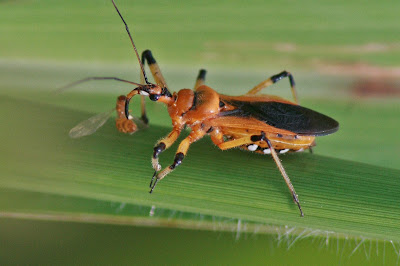
Assassin bugs (Family Heteroptera) are aptly named because they are predatory insects, feeding mainly on other insects. This hemipteran of the order Reduviidae has a relatively small and longish head with large compound eyes and a distinct sucking mouthparts. Their legs are fairly large and they effectively use it to grasp their prey. They puncture their victim with their elongated mouthparts and inject poisonous saliva which will dissolves tissues, before eventually suck their prey body fluid. Assassin bug with prey. Interestingly, assassin bugs are known to use chemical bait to catch their prey. Some species collect plant sap on their leg that attract other insects. Others secrete chemical that not only attract ants but also kill them. And one species spits poisonous chemical to paralyze its prey. Assassin bug uses its long mouthparts to feed on other insects. Except for those species that cause Chagas disease in South America, assassin bugs are not harmful to ma...

Crickets and Grasshoppers

Image
Crickets and grasshoppers belong to the insect order orthoptera. Orthoperans, which also include the katydids , are well-camouflaged insects that feed on living or dead vegetation matter using their biting mouthparts . They have two pairs of wing. The forewings are thicker than the hindwings. One of the distinctive characteristics of crickets and grasshoppers is their long and strong pair of hindlegs that enable them to jump quite a distance to evade danger, to move to another patch or to gain momentum as they take off to the air. The long antenna and ovipositor of a cricket. A grasshopper has short antenna. A prominent feature of crickets that distinguish them from grasshoppers is their thin and long antenna . As seen in the pictures above, the cricket’s antenna is longer than its body, whereas the grasshopper has much shorter antenna.  The ovipositor, a tubular structure that extends from the abdomen of insects for laying eggs, is much longer in crickets than ...

Insect Mouthparts

Image
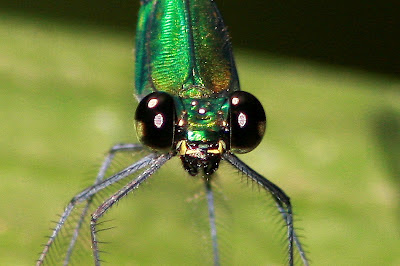
Basically, insect mouthparts consist of four modified appendages: labrum (upper lip), mandibles (jaws), maxillae (second jaws) and labium (lower lip). Mouthparts are categorized into two main groups: biting mouthparts and sucking mouthparts. A damselfly has biting mouthparts. Insects with biting mouthparts are usually those that eat vegetation or other insects. These insects use their muscle powered mandibles to chew and tear their food. Damselflies and grasshoppers are examples of this group of insects. The butterflies are insects with sucking mouthparts. What appear to be a tube are two elongated maxilla fused together. In butterflies, it is known as proboscis and it can curl inward. Proboscis of a butterfly. The mouthparts are adaptation of insects for different diet. Therefore, you can guess what type of mouthpart an insect possesses by observing its feeding behavior. Even within the same species, the mouthparts may differ depending on life stage. Take the ...

Labels

tropical fruit fruit hemiptera invasive species lizard spider Agamids animal camouflage arachnid butterfly camouflage mammals nest traditional medicine Lepidoptera adaptation antenna cuckoo insect camouflage insect mouthparts insect parts migrant birds moth poisonous plant predator reptile pictures snakes Cattle Egret Melastomataceae ants asssassin bug bird behaviour bird nest biting mouthparts cicada damselfly doves draco lizard egret flying dragon fungi ginger gliding lizards grasshopper heron hymenoptera insect adaptation invasive trees mangrove forest mangroves otter parasitoid proboscis rainforest plants shrike simple eyes sucking mouthparts vivipary wasp waterbird African Tulip Tree Ardea purpurea Asian fruits Asplenium Baya Weaver Beehive Ginger Bird's Nest Fern Black Bat Flower Black-naped Oriole Blattodea Bougainvillea Brown Shrike Butorides striatus Calotes versicolor Carica papaya Cat's Eye Fruit Cat's Whiskers Catclaw Mimosa Ceasarweed Centropus sinensis Cinnamon Bittern Clidemia hirta Colubridae Common Myna Congo Jute Coral swirl Dicranopteris linearis Dilleneaceae Dillenia Diptera Dollarbird Durians Durio zibethinus Dusky Langur Dusky Leaf Monkey Egretta garzetta Eurylaimidae Ficus Formicidae Garcinia mangostana Giant False Sensitive Mimosa Green Crested Lizard Ground Orchids Halcyon smyrnensis Hesperiidae Indian Rhododendron Indian mulberry Javan Myna Koster's Curse Lanius Lantana camara Little Egret Little Heron Macaranga tree Madagascar periwinkle Melastoma malabathricum Mimosa diplotricha Mimosa invisa Mimosa pigra Mimosa pudica Morinda citrifolia Nephelium lappaceum Odonates Oecophylla Orchidae Oriental Roller Plantain Squirrel Plumed Egret Pterophoridae Rafflesia Rambutan Rambutan tree Rosy periwinkle Rubiaceae Sensitive Plant Shrubby Simpoh Spathodea campanulata Spathoglottis plicata Stachytarpheta Striped Bronzeback Tacca chantrieri Urena lobata Varanus Water Hyacinth White-breasted Kingfisher White-breasted Waterhen White-throated Kingfisher Zingiber amphibians aphids aquatic plant banana flower banana musa barbet barn swallow bee bee flowers behaviour bird call bird foraging bird pollinated flowers bittern broadbills bufonidae bug bulbul bulbul pictures butcher bird castor bean castor oil caterpillar cauliflorous cauliflory chemoreception clavate antenna cockroach colubrid compound eyes costus speciosus crab spider crane fly cricket crow pheasant crypsis detrivore dove call dove song dragonfly ecdysis egret or heron epiphyte essential oil etlingera exoskeleton of an insect falconet fern fern plant ferns fiddler crab figs firefly fishtail palm flowerpecker fly frog gardening gastropod gerridae ginger flower greater coucal harvestmen hibiscus horticulture huntsman spider hydrophyte image of birds incomplete metamorphosis insect growth insect life cycle insect nymph insect vision introduced species jackfruit jacobson's organ jumping spider katydid kingfisher ladybug lampyridae langur larvae leafbird leafhopper leguminosae lilac long-tailed shrike longan lynx spider macaque malkoha malvaceae mango mango cultivars mangosteen mangrove ecosystem mangrove trees meliponines millipede mimicry molting molting lizard monitor lizard moulting process mudskipper mushroom mutualism nectar nephila non-venomous snake noni nonnative alien species nonnative species nonvenomous snakes nursery web spider nymph ocelli ommatidia orb weaver orb weaving spider orchid oriole orthoptera ovipositor painted bronzeback palms papaya papaya fruit parasitic plant passiflora passion flower passion vine pawpaw pectinate antenna pest pest birds pet birds pigeons pioneer species plant fiber plume pollination pollinators porterweed praying mantis preening primate prinia puddling pycnonotus rails rainforest lizard ranidae raptor red-tailed rat snake reduviidae resin robber fly root shrubs skinks skipper snail snakeweed spider web spores squirrel suboscines succession sunning symbiotic relationship tiger shrike toad tortoise beetle tree snake treehopper tropical rainforest urban birds venomous snake vipers water strider weaver ants weaver bird white white egrets wings wolf spider zingiberaceae zygodactyl feet
Show more