Posts

Showing posts with the label plants

Phyllagathis rotundifolia

Image
Phyllagathis rotundifolia Phyllagathis rotundifolia is a fairly common plant in forested areas, where it thrives in the humid and relatively dimly lit understory. A herbaceous member of the Melastomataceae family, it is a compact and sprawling plant often found along shaded trails. Its glossy, oppositely arranged leaves, with their prominent parallel veins, bear a resemblance to those of Clidemia hirta , another member of the melastome family. However, P. rotundifolia has broader leaves and exhibits a darker green pigmentation, an adaptation that helps it capture the scarce light available in the understory. Flowers of Pyllagathis rotundifolia The plant produces tiny yet striking purple flowers, held in panicles, creating a vivid contrast against the dark forest floor. Due to its neat, compact growth and attractive foliage, it is also cultivated as an ornamental plant. Plants within the Melastomataceae family are known for their anti-inflammatory and antimicrobial properties. In the ...

Sea Hibiscus

Image
Sea Hibiscus flowers just last a dawn-to-dusk. The Sea Hibiscus ( Hibiscus tiliaceus ) is a small flowering tree commonly found along beaches and mangroves. It can grow to heights exceeding 10 meters and is characterized by its heart-shaped leaves that are arranged alternately along the branches. The tree produces striking flowers, approximately 10 cm in diameter, which start as yellow with a darker base and gradually transition to a pinkish-orange hue. The fruit is a capsule with a persistent calyx that splits into several parts when ripe. Sea Hibiscus fruits change from green to brown as they mature. With a geographic range spanning the Indo-Pacific region and the Pacific Islands, this tree is known by various names, such as Waru in the Philippines and Bebaru in Malaysia. In parts of the Americas, where it is considered an invasive species, this member of the Malvaceae family is referred to as Mahoe . Sea Hibiscus growing along mangroves. The Sea Hibiscus can be used in landscaping...

Rafflesia Flower

Image
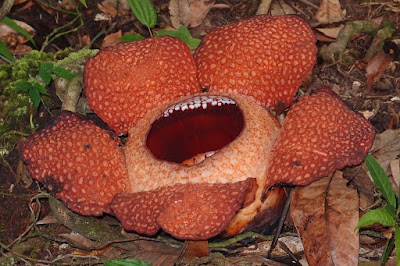
Blooming Rafflesia keithii Rafflesia is a remarkable plant not only because of its huge flower but also due to its unusual life history. Found in forested areas across southeast Asia, this parasitic plant lacks leaves and stem. As such, it is incapable to produce its own food via photosynthesis. Instead, it fully relies on its host, a ground rooted woody vine also called lianas. It penetrates its host using specialized root-like structure known as houstoria, spreading into the host’s vascular tissue to gain access to nutrients and water. Rafflesia flower bud The unisexual flower grows up to 3 feet wide and weighs up to 10 kilograms or so. Blooming occurs for less than a week, and like most flowers, Rafflesia flowers produce smell to attract insects. But unlike most flowers, the smell is unpleasant and often likened to the smell of carrion. Reportedly, this foul smell attracts its pollinator, a type of flies that travel over large distance and live for a few days, making...

Morinda citrifolia

Image
The multiple fruit of the Indian Mulberry The Indian Mulberry, also known scientifically as Morinda citrifolia is a valuable tree because almost all of it parts – leaves, fruits, barks and roots, are useful as a source of food, medicine and dyes. The young leaves are eaten as vegetables in Thailand and Indonesia. The fruit is also edible, but it is unpopular partly due to its unpleasant smell and mainly eaten during famine. Before the advent of modern dyes, the roots and barks were important source of dyes particularly for batik production in Java.  The flowering head of the Indian Mulberry contains many flowers. In traditional medicine, Morinda citrifolia has been used to treat a wide array of diseases and conditions that affect the digestive and respiratory system, as well as healing skin problems and wounds. In recent times, studies have shown that the seeds of Morinda citrifolia contain linoleic acid, a type of fatty acid which provides many health benefits...

Poisonous Plant: Lantana camara

Image
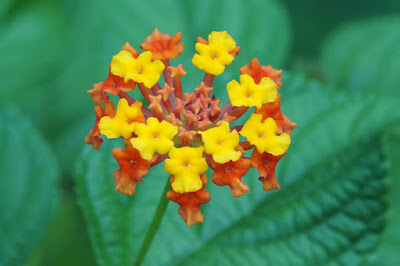
Flowers of Lantana camara . Originally brought from South America to this region for decorative purposes, Lantana camara has escaped into the wild where it thrived at clearings around villages, cultivation and forested areas. Owing to its toxicity, this shrubby plant belonging to the verbena family has become a cause of concern to the extent that it is categorized as an invasive species in some countries. Some ripe and unripe fruits of Lantana camara . The fruits, for instance, although appear edible, can cause serious implication if consumed. Indeed, fatal cases have been recorded especially among children. Ingestion of the leaves by ruminants such as cows and goats will lead to liver damage followed by death in a few days. Arrangement of leaves and flower clusters of Lantana camara . The unmistakable flower clusters are held on erect stalk from the leaf axil near the top. Most of the flowers are orange and yellow, but variations occur in which the flowers ...

Invasive Giant False Sensitive Mimosa

Image
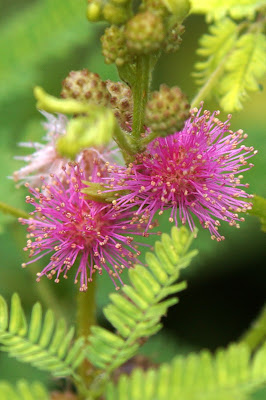
Giant False Sensitive Mimosa ( Mimosa diplotricha ) shares many features of its close relatives M. pudica . These legume has bipinnate leaves, composing of many leaflet which are sensitive to touch. What seems to be a single flower is actually numerous flowers held on a single head. Each of those tiny flower has long stamens forming a fluffy structure. A native plant of South America, Giant False Sensitive Mimosa has dispersed far and wide not only in Southeast Asia, but also in Polynesia and Taiwan. Flowers of Giant False Sensitive Mimosa. Their successful colonisation in the tropics is partly due to its fruit which readily float on water, along with the fruit's spiky outer skin which easily attaches to animals and human as well. The seeds also germinate fast in the right habitat where there is a lot of sunlight, and if condition is unsuitable, they can also lay dormant for years before germinating. Sprawling growth of Giant False Sensitive Mimosa. They are c...

Jackfruit

Image
Jackfruit ( Artocarpus heterophyllus ), a native plant of India, is a common fruit tree in Southeast Asia where it fruits all year round--in contrast to other local fruit trees like rambutan and mangosteen that produce fruit seasonally. The fruit bears some resemblance to the durian , but it has shorter spikes and the barrel-shaped fruit is among the largest tropical fruit, reaching up to 20 inch across. Jackfruit ( Artocarpus heterophyllus ) Similar to its close relative of the same family, the fig tree, jackfruit is cauliflorous, bearing flowers and fruits on the trunk and main branches. It has a dense and neat crown with thick and dark glossy-green leaves, rendering itself a suitable garden plant, too. Jackfruit is easily propagated from seed, growing up to 60 feet tall and start producing fruit after about three years. Jackfruits contain starch, minerals and vitamins. The fruit of this wind pollinated tree contains numerous seeds, each about 1.5 inch long and c...

Snakeweed

Image
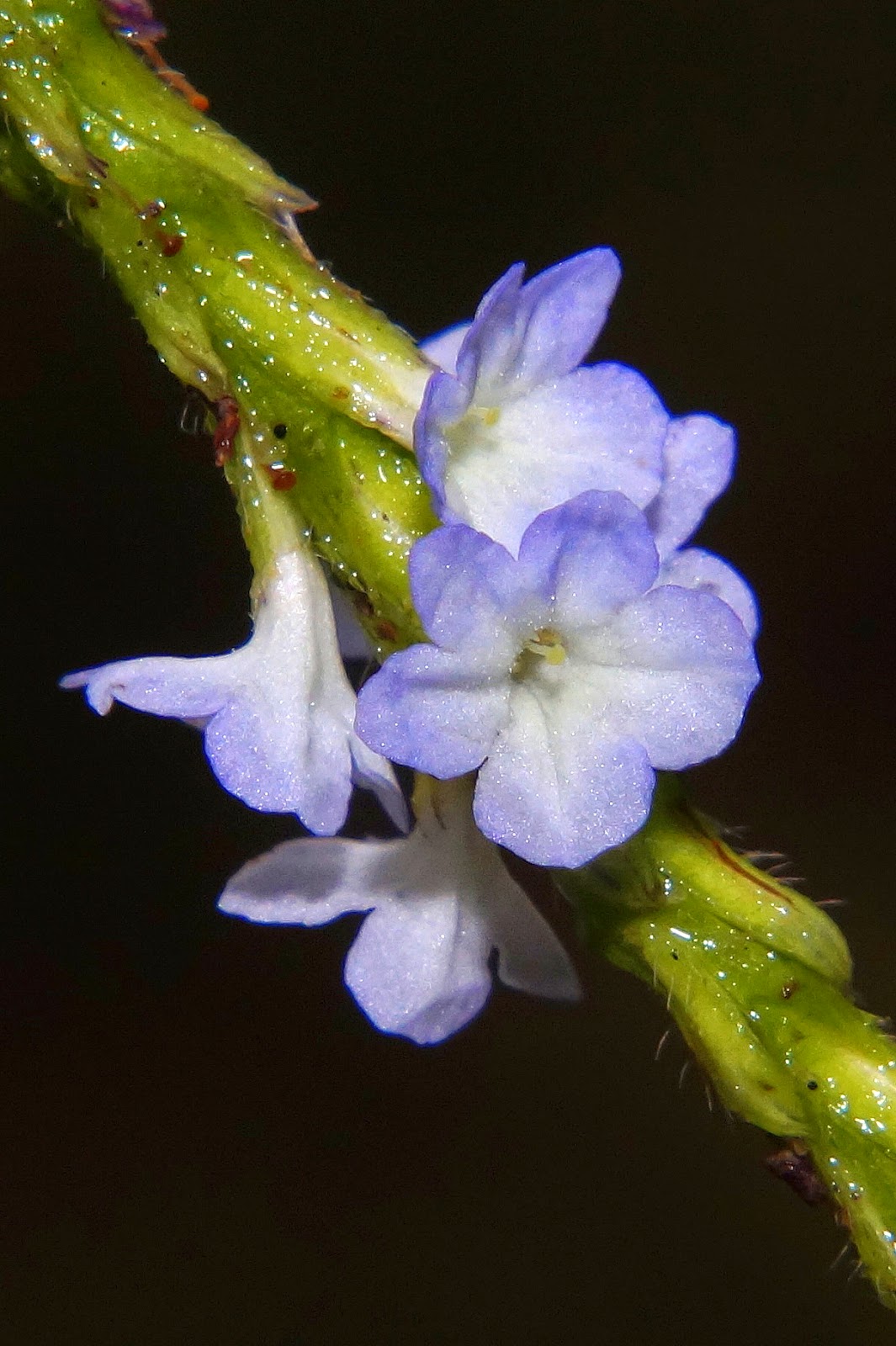
The Snakeweed ( Stachytarpheta spp.), also called Porterweed, is an introduced species originated from South America. A shrub reaching up to 2 m, it exhibits many typical features of the family Verbenaceae in which in belongs. The leaves, for example, are oppositely arranged, and the flowers are tubular, each with five 5 petals. Snakeweed flowers may be blue, light blue or white. Snakeweed’s flowers are borne on elongated spikes, and the flowers come in different colors ranging from white, light blue to deep blue. This characteristic may help identification for several species looks very similar to the novice in many aspects except for the flowers. A case in point is Stachytarpheta Cayennensis and S. jamaicensis which may produce white and blue flowers respectively. Snakeweed leaves are oppositely arranged. Throughout its distribution in Southeast Asia, snakeweed is known by different names including Limbagat (Philippines), Gewongan (Indonesia), Selasih Dandi (Ma...

Animal Pollinated Flowers

Image
Because pollination requires suitable pollinator to be successful, animal pollinated flowers have developed a variety of colors, scent and sizes; thus, restricting the kind of animals that visit them. Consequently, only animals with the right characteristics can feed on the nectar, and in return pollinate the flowers. A butterfly uses its proboscis to feed on nectar. Insects generally has keen sense of sight, hence they tend to visit colorful flowers. Butterflies, for example, often visit red, orange and yellow flowers, including those with long tubular tube for they can easily reach the nectar using their long sucking mouthparts .  In contrast, bees cannot see red but they can see blue. This explains why many bee flowers are blue or violet. Bees are attracted to blue, purple and violet flowers. Time of opening also played a crucial part in attracting the right pollinators. Some flowers open at night like those of durian , which are pollinated by bats. Strongly...

Wild Gingers in the Rainforest

Image
The rainforest ecosystem in Southeast Asia is home to many species of gingers (family Zingiberaceae), each with distinctive flowers that may greatly aid identification. The most famous because of its value as a garden plant is the Torch Ginger ( Etlingera elatior ), which has a large flower borne on a rather long stem that grows vertically from the soil. Etlingera littoralis flower A lesser known ginger of the genus Etlingera is E. littoralis . In contrast to E. elatior , it has red flower that grows directly on the ground. Some forms of this ginger have yellow-bordered flower petals particularly those found around southern Thailand. Both species is beneficial as food and medication. For instance, the flower of E. elatior and the fruit of E. littoralis are edible. The former is also helpful in treating headache and stomachache. Inflorescence of Costus speciosus More conspicuous than those species mentioned earlier is Costus specious , because of its ability to grow ...

Fishtail Palm

Image
The Fishtail Palm ( Caryota mitis ) derives its name from its delta-shaped, fishtail-like leaflet with ragged ends. It has the characteristics monocot leaf with parallel veins readily seen in many other palm species as well. Additionally, like all palms, it also lack wood, bark and side branches often seen in dicot trees. Leaflets of Fishtail Palm A palm tree native to Southeast Asia, this quick growing palm can reach a height of up to 12 meters. The slightly curved leaves can measure up to three meters and the leaflets usually range from 10-20 centimeters. It has been used in landscaping quite extensively as a screening, tall hedges and even interiorscape. Flowers and fruits of Fishtail Palm are borne on dense cluster of string. The rounded fruits are borne on long hanging stalks. Although they might appear edible, the fruits contain highly irritating calcium oxalates crystals. When this crystals puncture the skin, it cause intense itching, and highly irritating to th...

Mango Fruit Tree

Image
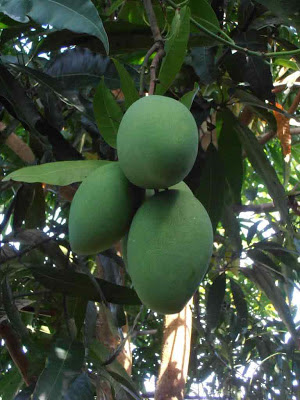
One of the oldest known fruit trees cultivated by man, the mango tree ( Mangifera indica ) originated from India and Southeast Asia, where it has been planted for over 4000 years mainly for its fruit. Crossings between various individual trees have produce hundreds if not thousands of mango cultivars. Each mango cultivar has its own smell, taste, size and time of maturity, among other characteristics.  Mango fruit In Thailand, cultivars are classified as either that that is eaten ripe or unripe. The former includes   Rad , and the latter includes Okrong which is very sweet, juicy and greenish-yellow in colour. In India, one of the most popular mango cultivars is the Neelam , a highly fragrant cultivar with high keeping quality and yellow saffron coloured fruit. The mango tree itself is beautiful making it suitable for gardens. The crown is more or less rounded, and the alternately arranged dark green leaves are crowded toward the tip. Young leaves, however, is r...

Poisonous Plant: Castor Bean

Image
The Castor Bean ( Ricinus communis ) is easily identified by its palmately lobed leaves with toothed margin held by a rather long stalk.  It originated from parts of Africa and Middle East but now has spread to many tropical countries where it grows along rivers, roadside and disturbed places.  Inside the capsular fruit, which is covered with soft bristles, are several smooth and glossy seeds or beans. Castor Bean leaves Castor Bean is most notable for its poisonous properties, due to the presence of ricin especially inside the seed.  Ricin can enter the cell and block protein production, a critical process for living organisms. Eating the seeds causes stomach pain, water loss, nausea, vomiting, and in severe cases death. Castor Bean fruits Despite its reputation as a poisonous plant, the oil extracted from this plant has many benefits. Aside from being used as lubricants, Castor oil is also used in the production of varnishes, polishes and ink. In medicin...

Water Hyacinth

Image
Water Hyacinth, a floating water plant, is widespread in a variety of damp habitat like rivers, ponds and reservoirs. It is regarded as an invasive species in many countries because it grows abundantly and negatively affected the local ecosystem. Flower and swollen petiole of Water Hyacinth. Typical of a hydrophyte, that is plant that submerged or partially submerged underwater, Water Hyacinth is equipped with a number of adaptations to help it float. The most obvious adaptation is the swollen petiole, or leave stalk that contains air chambers, which functions like an air bladder for buoyancy. Inside the stem are aerenchyma, tissues with large air space that not only aid buoyancy, but also funnel air from the shoot to the root that remain underwater. By reproducing asexually, this water plant can produce thousands of individuals in only a few months. It does so by generating stolon, a horizontal stem, which on certain point of its surface can produce new individuals. T...

Banana Flowers

Image
Banana flowers The banana tree ( Musa sp.) is essentially a large herb most notable for its fruits. The large flowers are in many cases dioecious, that is the female and male flowers are present in the same plant. The inflorescence initially starts out at the tip of the plant. In the beginning, it is erect but eventually bends downwards. At first, only the female banana flowers develop in cluster around the thick long stalk. They are often referred as hands, and each finger will eventually become the fruit. As the fruits develop, the stalk continues to grow, and the male flowers will appear near the end, at the axil of the conspicuous bracts.

Uses of the Madagascar Periwinkle

Image
Despite its name, the Madagascar periwinkle ( Catharanthus roseus madagascariensis ) is believed to be native to Central America, specifically the Caribbean. A widely used garden plant, the Madagascar periwinkle is especially useful as covering plant by growing them in large numbers around other plants, particularly those with larger flowers. Periwinkle flowers However, it is in medicine that the Madagascar periwinkle as been proven highly beneficial.  In many tropical countries including those in Africa, Southeast Asia and the Indian subcontinent, this plant is utilized in traditional medicine to cure various ailments like heart condition, diabetes, indigestion and toothache. More importantly, modern medicine has been using the alkaloids extracted from the Madagascar periwinkle to treat certain types of cancer. It is so effective to the extent that the chance of surviving some form of cancer such as pediatric leukemia has increased dramatically. The Madagascar periwinkle...

Passion Flower Vine

Image
Passion Flower Vine A plant genus consisting of more than 400 species, passion flower vine ( Passiflora sp.)  is a climbing plant originated in South America. Reaching up to 90 feet in length, this climber uses tendrils to climb trees, but the flowers are borne in lower level because many of its pollinators tend to be found in the lower storey. The flower of passion vine is unmistakable, and easily identified by the corona that consists of numerous thread-like spikes.  Passion flower comes in various colours including blue, purple and red. The spectacular passion flowers are borne singly, each with 5 petals and sepals. At the center of the flower is the stamen, the female organs, with three stigmas where the pollens land at the initial stage of fertilization.  Just below them are the male organs or stamens. There are typically five stamens in each flower.  Depending of species, passion vine flowers are pollinated by butterflies, bees, bats and ...

Fern Plant

Image
The ferns are seedless plant, and unlike more primitive plants such as the mosses, they have water vessels made of cells arranged in a tube-like fashion, which functions in water transport. Ferns reproduce primarily via spores. If the spores are able to disperse, mostly by wind, to suitable habitat, it will generate the next life stage which will produce the eggs and sperms required to produce the fern plants that we usually see. If you look at the underside of fern leaves, you might see small rounded spots, or sori, containing numerous microscopic enclosures, each contains plentiful of spores. Each sori consists of numerous spores-containing sacs. There are many types of fern plants—some has the leaves or stem growing directly upward from a rhizome or rootstalk, which creep above or just below the ground. For example, the fern Dicranopteris linearis , apart from dispersing using spores, also spread by way of creeping rhizome, forming thick thicket especially in cleared land a...

Melastoma malabathricum

Image
Melastoma malabathricum is a very common shrub in open places including forest edge, wasteland and rural road. Also known as Indian Rhododendron, its distribution includes the Indian subcontinent, Southeast Asia, Polynesia and Hawaii. The flowers and leaves of Melastoma malabathricum . It resembles Clidemia hirta in certain characteristics for both of them are members of the Melastomataceae family. For example, the leaves are opposite in arrangement with 3-5 parallel veins. M. malabathricum , however, has brownish red stems covered with tiny scales. The 5 petalled, purple flowers are very showy, and they are held at the end of the twigs. Ten yellow stamens are present on each flower; 5 of those are longer with the upper half are purple and curved. The black berry of Melastoma malabathricum contains numerous tiny seeds. The evergreen Melastoma  malabathricum does not seem to have any definite flowering and fruiting season. Since the flowers and fruits are used a...

African Tulip Tree

Image
Although its name suggests that it is a member of the Tulip family (Liliaceae), the fact is the African Tulip Tree ( Spathodea campanulata ) is classified into the Bignoniaceae family. Also known as the Fountain Tree, it is a fast growing, evergreen tree whose origin is in the tropical African rainforest. Mature trees can reach up to 30m and grow buttresses at the base.  African Tulip Tree flowers and unripe pods The African Tulip Tree has been introduced in many part of the tropical region because of its horticultural value. It makes a good shade tree, and it will produce spectacular orange or yellow flowers. Because the flowers are borne on the terminal branches, so naturally one can only fully appreciates their beauty when the plant is still small or when looking down from a high rise building. Like so many non-native species, the African Tulip Tree can be detrimental to the natural environment. In Hawaii, it is an invasive tree species and listed as one of the most ...

Labels

tropical fruit fruit hemiptera invasive species lizard spider Agamids animal camouflage arachnid butterfly camouflage mammals nest traditional medicine Lepidoptera adaptation antenna cuckoo insect camouflage insect mouthparts insect parts migrant birds moth poisonous plant predator reptile pictures snakes Cattle Egret Melastomataceae ants asssassin bug bird behaviour bird nest biting mouthparts cicada damselfly doves draco lizard egret flying dragon fungi ginger gliding lizards grasshopper heron hymenoptera insect adaptation invasive trees mangrove forest mangroves otter parasitoid proboscis rainforest plants shrike simple eyes sucking mouthparts vivipary wasp waterbird African Tulip Tree Ardea purpurea Asian fruits Asplenium Baya Weaver Beehive Ginger Bird's Nest Fern Black Bat Flower Black-naped Oriole Blattodea Bougainvillea Brown Shrike Butorides striatus Calotes versicolor Carica papaya Cat's Eye Fruit Cat's Whiskers Catclaw Mimosa Ceasarweed Centropus sinensis Cinnamon Bittern Clidemia hirta Colubridae Common Myna Congo Jute Coral swirl Dicranopteris linearis Dilleneaceae Dillenia Diptera Dollarbird Durians Durio zibethinus Dusky Langur Dusky Leaf Monkey Egretta garzetta Eurylaimidae Ficus Formicidae Garcinia mangostana Giant False Sensitive Mimosa Green Crested Lizard Ground Orchids Halcyon smyrnensis Hesperiidae Indian Rhododendron Indian mulberry Javan Myna Koster's Curse Lanius Lantana camara Little Egret Little Heron Macaranga tree Madagascar periwinkle Melastoma malabathricum Mimosa diplotricha Mimosa invisa Mimosa pigra Mimosa pudica Morinda citrifolia Nephelium lappaceum Odonates Oecophylla Orchidae Oriental Roller Plantain Squirrel Plumed Egret Pterophoridae Rafflesia Rambutan Rambutan tree Rosy periwinkle Rubiaceae Sensitive Plant Shrubby Simpoh Spathodea campanulata Spathoglottis plicata Stachytarpheta Striped Bronzeback Tacca chantrieri Urena lobata Varanus Water Hyacinth White-breasted Kingfisher White-breasted Waterhen White-throated Kingfisher Zingiber amphibians aphids aquatic plant banana flower banana musa barbet barn swallow bee bee flowers behaviour bird call bird foraging bird pollinated flowers bittern broadbills bufonidae bug bulbul bulbul pictures butcher bird castor bean castor oil caterpillar cauliflorous cauliflory chemoreception clavate antenna cockroach colubrid compound eyes costus speciosus crab spider crane fly cricket crow pheasant crypsis detrivore dove call dove song dragonfly ecdysis egret or heron epiphyte essential oil etlingera exoskeleton of an insect falconet fern fern plant ferns fiddler crab figs firefly fishtail palm flowerpecker fly frog gardening gastropod gerridae ginger flower greater coucal harvestmen hibiscus horticulture huntsman spider hydrophyte image of birds incomplete metamorphosis insect growth insect life cycle insect nymph insect vision introduced species jackfruit jacobson's organ jumping spider katydid kingfisher ladybug lampyridae langur larvae leafbird leafhopper leguminosae lilac long-tailed shrike longan lynx spider macaque malkoha malvaceae mango mango cultivars mangosteen mangrove ecosystem mangrove trees meliponines millipede mimicry molting molting lizard monitor lizard moulting process mudskipper mushroom mutualism nectar nephila non-venomous snake noni nonnative alien species nonnative species nonvenomous snakes nursery web spider nymph ocelli ommatidia orb weaver orb weaving spider orchid oriole orthoptera ovipositor painted bronzeback palms papaya papaya fruit parasitic plant passiflora passion flower passion vine pawpaw pectinate antenna pest pest birds pet birds pigeons pioneer species plant fiber plume pollination pollinators porterweed praying mantis preening primate prinia puddling pycnonotus rails rainforest lizard ranidae raptor red-tailed rat snake reduviidae resin robber fly root shrubs skinks skipper snail snakeweed spider web spores squirrel suboscines succession sunning symbiotic relationship tiger shrike toad tortoise beetle tree snake treehopper tropical rainforest urban birds venomous snake vipers water strider weaver ants weaver bird white white egrets wings wolf spider zingiberaceae zygodactyl feet
Show more