Posts

Showing posts with the label spider

Wolf Spider

Image
A wolf spider carrying its egg sac. Wolf spiders do not build webs to trap their prey, but like huntsman spiders, they actively stalk and ambush them. Their eyes are perfectly adapted for this hunting strategy, being arranged in three rows. The two large, forward-facing median eyes in the posterior row and smaller lateral eyes positioned at the sides enable them to scan their surroundings for prey, which includes insects and other small invertebrates. A female wolf spider with spiderlings on its back. Though they don’t spin hunting webs, wolf spiders do produce silk which they use to construct egg sacs. After hatching, the spiderlings climb onto their mother’s abdomen, where they remain for a week or two before dispersing. Members of the family Lycosidae, wolf spiders are typically small (most under one inch in body length) and often brown with darker markings  They thrive in diverse habitats, from forest floors and sandy stream banks to rocky crevices and low vegetation like ferns...
Eye Arrangement of Spiders

Image
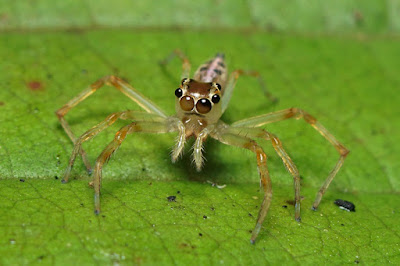
Because of the sheer number of spider species this region, identifying a spider can be a daunting task especially for the amateur naturalist. However, in many cases the arrangement, size as well as the number of eyes can greatly help one identify the family or genus of a spider. Jumping spider has two enlarged forward pointing eyes. For a large majority of spiders, eight eyes in four pairs is the norm. However, spiders with three pairs of eyes or even eyeless also existed but they are rare. These simple eyes, also known as ocelli, are generally arranged in two rows, and their relative size and position are useful features to look for when identifying a spider. Nursery web spider has similar-sized eyes. The jumping spider, for example, has enlarge middle two eyes of the front row that point forward.  The wolf spider also has two large eyes, but they are of the second row. The nursery web spider might be mistaken for a wolf spider, but their eyes are approximately of...

Spider Hunting Techniques

Image
Many of us are familiar with web spinning spiders like the orb weaver spider , which uses its elaborately constructed web to trap prey. However, like other predators, spiders have developed a variety of hunting techniques to catch prey. A crab spider capturing a bee. The crab spider for example, often lays waiting for their unsuspecting prey, usually inside a flower or sometimes inside a partly folded young leave. It has the additional advantage of being well camouflage for its body color matches its surrounding. A species of crab spider that habitually stays waiting inside the flower of Urena lobata , for instance, has the pinkish coloration of the flower as well. They are called crab spider for their crab-like leg arrangement as well as their sideways movement. Although tiny, this arachnid is capable of capturing prey much larger than itself like bees and flies. A huntsman spider in a house. In contrast, other group of spiders such as the jumping spider and hunts...

Harvestmen Spider

Image
A harvestment in the rainforest. Although they look a lot like spiders with their four pair of legs, this arachnid belongs to a different order known as Opiliones. Like spiders, their body also consists of two parts. However, unlike spiders, the region between the front and the rear part is not constricted, making the body appear as a single unit. A spider is also an arachnid. Harvestmen derive their name from the fact that they are abundant during the harvest season in England, and possibly because of their leg’s reaction when it broken off from the body resemble a farmer’s scythe movement. Harvestmen lack silk gland but they have scent gland that emits foul smell especially when threatened by potential enemies. For this reason, they are also known as stink bug in parts of south America. A harvestmen on the underside of a leave. Harvestmen are unique among arachnids, which not only includes the spiders but also mites, ticks and scorpions, for having an omnivo...

Golden Orb Weaver

Image
The female Golden Orb-Weaver ( Nephila sp.) is a large spider, with golden sheen on its body, eight eyes and long slender legs. By contrast, the male is much smaller than the female. Similar to many spiders, this orb weaving spider build web made of silk, which is stronger than steel but remarkably flexible. Its web can be as large as six feet across, and it is usually constructed between two trees in the rainforest. Orb weaver spiders have a habit of making their web across trails low above the ground, but it may also be built high up in the trees. One of the characteristics of their vertical web is that it is much broader at the lower half.  Golden Orb Weaver When alerted of a trapped prey, it will immediately wrap it with silk before injecting venom-different from some other spiders that bite before wrapping their victims. Typical of spiders, the orb weaver spiders cannot feed on solid food directly. When feeding, it continuously pour out digestive juice into its p...

Labels

tropical fruit fruit hemiptera invasive species lizard spider Agamids animal camouflage arachnid butterfly camouflage mammals nest traditional medicine Lepidoptera adaptation antenna cuckoo insect camouflage insect mouthparts insect parts migrant birds moth poisonous plant predator reptile pictures snakes Cattle Egret Melastomataceae ants asssassin bug bird behaviour bird nest biting mouthparts cicada damselfly doves draco lizard egret flying dragon fungi ginger gliding lizards grasshopper heron hymenoptera insect adaptation invasive trees mangrove forest mangroves otter parasitoid proboscis rainforest plants shrike simple eyes sucking mouthparts vivipary wasp waterbird African Tulip Tree Ardea purpurea Asian fruits Asplenium Baya Weaver Beehive Ginger Bird's Nest Fern Black Bat Flower Black-naped Oriole Blattodea Bougainvillea Brown Shrike Butorides striatus Calotes versicolor Carica papaya Cat's Eye Fruit Cat's Whiskers Catclaw Mimosa Ceasarweed Centropus sinensis Cinnamon Bittern Clidemia hirta Colubridae Common Myna Congo Jute Coral swirl Dicranopteris linearis Dilleneaceae Dillenia Diptera Dollarbird Durians Durio zibethinus Dusky Langur Dusky Leaf Monkey Egretta garzetta Eurylaimidae Ficus Formicidae Garcinia mangostana Giant False Sensitive Mimosa Green Crested Lizard Ground Orchids Halcyon smyrnensis Hesperiidae Indian Rhododendron Indian mulberry Javan Myna Koster's Curse Lanius Lantana camara Little Egret Little Heron Macaranga tree Madagascar periwinkle Melastoma malabathricum Mimosa diplotricha Mimosa invisa Mimosa pigra Mimosa pudica Morinda citrifolia Nephelium lappaceum Odonates Oecophylla Orchidae Oriental Roller Plantain Squirrel Plumed Egret Pterophoridae Rafflesia Rambutan Rambutan tree Rosy periwinkle Rubiaceae Sensitive Plant Shrubby Simpoh Spathodea campanulata Spathoglottis plicata Stachytarpheta Striped Bronzeback Tacca chantrieri Urena lobata Varanus Water Hyacinth White-breasted Kingfisher White-breasted Waterhen White-throated Kingfisher Zingiber amphibians aphids aquatic plant banana flower banana musa barbet barn swallow bee bee flowers behaviour bird call bird foraging bird pollinated flowers bittern broadbills bufonidae bug bulbul bulbul pictures butcher bird castor bean castor oil caterpillar cauliflorous cauliflory chemoreception clavate antenna cockroach colubrid compound eyes costus speciosus crab spider crane fly cricket crow pheasant crypsis detrivore dove call dove song dragonfly ecdysis egret or heron epiphyte essential oil etlingera exoskeleton of an insect falconet fern fern plant ferns fiddler crab figs firefly fishtail palm flowerpecker fly frog gardening gastropod gerridae ginger flower greater coucal harvestmen hibiscus horticulture huntsman spider hydrophyte image of birds incomplete metamorphosis insect growth insect life cycle insect nymph insect vision introduced species jackfruit jacobson's organ jumping spider katydid kingfisher ladybug lampyridae langur larvae leafbird leafhopper leguminosae lilac long-tailed shrike longan lynx spider macaque malkoha malvaceae mango mango cultivars mangosteen mangrove ecosystem mangrove trees meliponines millipede mimicry molting molting lizard monitor lizard moulting process mudskipper mushroom mutualism nectar nephila non-venomous snake noni nonnative alien species nonnative species nonvenomous snakes nursery web spider nymph ocelli ommatidia orb weaver orb weaving spider orchid oriole orthoptera ovipositor painted bronzeback palms papaya papaya fruit parasitic plant passiflora passion flower passion vine pawpaw pectinate antenna pest pest birds pet birds pigeons pioneer species plant fiber plume pollination pollinators porterweed praying mantis preening primate prinia puddling pycnonotus rails rainforest lizard ranidae raptor red-tailed rat snake reduviidae resin robber fly root shrubs skinks skipper snail snakeweed spider web spores squirrel suboscines succession sunning symbiotic relationship tiger shrike toad tortoise beetle tree snake treehopper tropical rainforest urban birds venomous snake vipers water strider weaver ants weaver bird white white egrets wings wolf spider zingiberaceae zygodactyl feet
Show more