Posts

Showing posts with the label reptiles

Non-Venomous Colubrid Snakes
Image
The Colubrid is a large family of snake found almost in all continents. Some species are only a few inches long, whereas other may reach over a few meters in length. In forested habitat, these snakes inhabit the trees or the ground, and some species live near water and in caves. Small creatures like rats, bats and insects are part of their diet. Because snakes belonging the family Colubridae are non-venomous snakes, they are harmless to man, however, a number of species have toxic saliva harmful to their prey. Red-Tailed Rat Snake This family is further subdivided into several groups like the rat snakes and the bronzeback tree snakes. The Red-Tailed Rat Snake ( Gonyosoma oxycephalum) , for example, is striking green with yellowish belly, dark eye-line and bluish-black tongue. It derives its name from its reddish tail tip. Some people keep this snake as a pet because of it beautiful coloration. Painted Bronzeback Slenderer than the previous species is the Painted Br...

Wagler's Pit Viper

Image
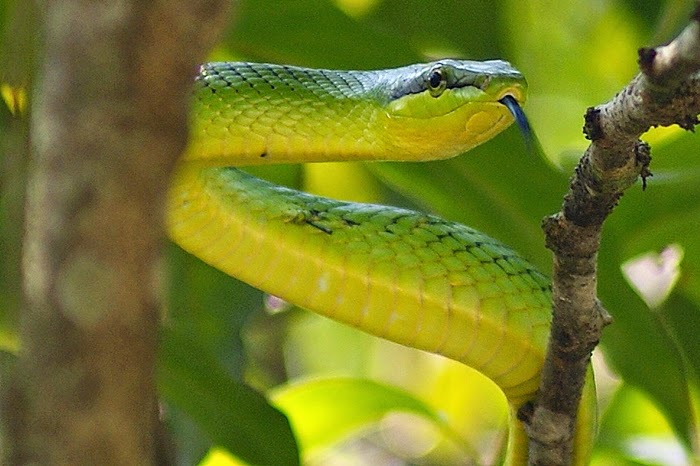
This is the most commonly encountered vipers in the rainforest, usually seen laying still on low branches in the understorey. Wagler’s Pit Viper ( Tropidolaemus wagleri ) is a beautiful venomous snake with a docile disposition for it seldom attempt to bite. The effect of the venom is comparatively mild to humans and most bites lead to localized swelling and not fatal. In the island of Penang at the west coast of peninsular Malaysia, they are left freely within a temple, thus their different name−Temple Snake. Adult Wagler's Pit Viper Thick bodied, dark green to almost black above and yellow below, adult Wagler’s Pit Viper can reach up to a meter in length. The much slenderer juvenile has different coloration with lighter green above dotted regularly with white and reddish spots, which contrast with the white underparts, and a distinct reddish line runs across its eyes. Juvenile Wagler's Pit Viper The name pit viper refers to the heat sensing organs locate...

Type of Lizards: Skinks

Image
The skinks (Scincidae family) are one of the most likely reptiles to be seen in wooded habitat. Among their chief characteristics is their cylindrical and smooth-scaled body. They differ from Agamid lizards and gliding lizards by lacking crests or gular pouch outside their body. A skink on the rainforest floor. Many types of skink exist, from those with four short limbs, each with five digits, to the limbless ones that lead a burrowing lifestyle. In the rainforest, skinks inhabit the forest floor, where they are usually seen sunning in patches of sunlight or scurrying for cover. Some species are also arboreal, living on tree trunks and branches. When disturbed, they may hide inside crevices or underneath leave of climbers. Some skinks are arboreal. Like snakes, skinks use chemoreception to find food, mate, and to avoid predator. They do so by flicking their tongue to collect chemical in the air and bring it to the Jacobson’s organ, a sense organ on the roof of the mo...

Oriental Garden Lizard

Image
The Oriental Garden Lizard ( Calotes versicolor ) is one of the common species of reptiles in parks, gardens, villages and cultivations. It is readily seen sunning on exposed low branches, fences and rural roads. When one comes too close, it habitually runs for cover or dive into the undergrowth. Because it can change colour, it is also call the Changeable Lizard, and can be mistaken for a chameleon. Male Oriental Garden Lizard Typical of Agamid lizards, it has a series of upward pointing triangular scales on its head, which become smaller as it runs down its back. Numerous variable sized, backward pointing scales cover the body of this small reptile. Surrounding the eyes are movable eyelids, visible up close. The body is somewhat triangular in cross-section: the underneath being flattened and the sides compressed toward the top. Generally, the male are larger than female, reaching one foot in length. Oriental Garden lizards fight over territory. In breeding season, th...

Animal Camouflage: Gliding Lizard

Image
Gliding lizards utilize camouflage to avoid predator. To avoid predation, many reptiles in the rainforest including gliding lizard (also called Draco lizard or flying dragon) take advantage of camouflage as shown in the photo above. Its body colour mixed very well with the tree bark.  The irregular blotches on its body also blended with the variable colours and patterns of the surrounding thus producing an effective camouflage. If it did not raise its head but instead place it on the vertical trunk with its tail extended, it would almost certainly be unnoticed. In addition to camouflage, gliding lizard also relies on speed to flee from potential predator. It can scurry up tree trunk, and then stays motionless to minimize detection. Remarkably, gliding lizard, as its name implies, can escape predator by making a steep glide, then maneuver itself for some distance  before landing on a another tree, using its claw to cling on tree trunk.

Monitor Lizard

Image
Quite a number of Varanus monitor lizards species are frequently seen in the wild; nonetheless watching them is still an exciting experience for  they are elegant and prehistoric looking and not much is known about them despite their widespread occurrence. The Clouded Monitor ( Varanus bengalensis ), a largely grey or brown lizard with yellow spottings is perhaps the most likely to be encountered. Others like the Water Monitor ( Varanus salvator ) are also quite common but they are restricted near rivers.  A monitor lizard watching its surrounding Found not only in damp location, but also nearby dry scrubs, plantations and villages, the Clouded Monitor is a successful creature when it comes to adapting near man made habitat. One possible factor for its extensive distribution is perhaps it wide range of foods including small reptiles and mammals, fishes and crustaceans, and also carrion. These reptiles may appear formidable, especially the larger si...

Molting Lizard

Image
An Agamid lizard molting in the bushes. Typical of reptile, lizards also undergo molting whereby they shed their old skin as the body becomes larger. But unlike snakes that shed large chunks of skins during molting, lizard skins peel off in small pieces. They are also known to eat their shed skin, a source of protein.

Beautiful Tree Snake

Image
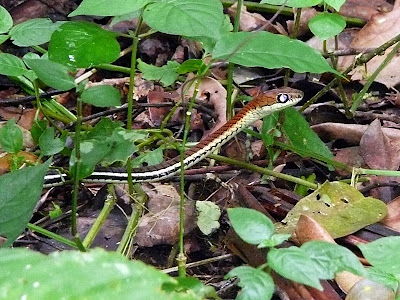
Striped Bronzeback Tree Snake Not only the tropical rainforest is rich in avifauna and plant diversity, but  also snakes which include various species of arboreal or tree dwelling snakes. The Striped Bronzeback ( Dendrelaphis caudolineatus ), a beautiful snake with red and black stripes and relatively large eyes is one of them. Although it spends much of its time in the rainforest trees, it does come down to the ground like the individual in the picture. Since it is a non-venomous snake, the snake's bite is not fatal but it can cause a minor cut.  In the wild the Striped Bronzedback are known to prey on other small animal in the rainforest such as a tree lizard. Related Post Non-Venomous Colubrid Snakes

Draco Lizards - Flying Dragon of the Rainforest

Draco lizards is one of the most amazing animals in the rainforest. Found in the rainforest of Southeast Asia, Draco lizards are notable for its ability to "fly", or more accurately described as gliding from tree to tree. It could do by using a flap of skin on each side of its body - also known as patagia, that can be erected as to turn into some form of "wings" so it can leap then glide acros the forest trees. Largely arboreal, this rainforest's lizard feeds mainly on ants and termites on the tree trunk. However, in order to lay eggs, the female has to come down to the ground where she dig a hole with her snout and lay her eggs in it. Another futures of this gliding lizard is a flap of skin under the throat of males that can be erected. In some individuals it is brightly coloured, and serves as communication purpose to ward off potential intruders or competing males.

Animal Camouflage: Lizard

Image
The Oriole is oblivious to the Agamid lizard clinging vertically on the tree trunk.

Sunning Agamid Lizard

Image
The Green Crested Lizard is quite common in wooded areas throughout this region. This attractive Agamid lizard has a  jagged crest on its neck and a relatively long tail. It is usually detected as it falls from branches or leap across the forest trail from tree to tree. This particular individual sunning itself in the afternoon near a stream, probably to thermo-regulate its body temperature since it is a cold blooded animal. Noteworthy that sun-basking behaviour of reptiles is also crucial in order to acquire vitamin D.

Labels

tropical fruit fruit hemiptera invasive species lizard spider Agamids animal camouflage arachnid butterfly camouflage mammals nest traditional medicine Lepidoptera adaptation antenna cuckoo insect camouflage insect mouthparts insect parts migrant birds moth poisonous plant predator reptile pictures snakes Cattle Egret Melastomataceae ants asssassin bug bird behaviour bird nest biting mouthparts cicada damselfly doves draco lizard egret flying dragon fungi ginger gliding lizards grasshopper heron hymenoptera insect adaptation invasive trees mangrove forest mangroves otter parasitoid proboscis rainforest plants shrike simple eyes sucking mouthparts vivipary wasp waterbird African Tulip Tree Ardea purpurea Asian fruits Asplenium Baya Weaver Beehive Ginger Bird's Nest Fern Black Bat Flower Black-naped Oriole Blattodea Bougainvillea Brown Shrike Butorides striatus Calotes versicolor Carica papaya Cat's Eye Fruit Cat's Whiskers Catclaw Mimosa Ceasarweed Centropus sinensis Cinnamon Bittern Clidemia hirta Colubridae Common Myna Congo Jute Coral swirl Dicranopteris linearis Dilleneaceae Dillenia Diptera Dollarbird Durians Durio zibethinus Dusky Langur Dusky Leaf Monkey Egretta garzetta Eurylaimidae Ficus Formicidae Garcinia mangostana Giant False Sensitive Mimosa Green Crested Lizard Ground Orchids Halcyon smyrnensis Hesperiidae Indian Rhododendron Indian mulberry Javan Myna Koster's Curse Lanius Lantana camara Little Egret Little Heron Macaranga tree Madagascar periwinkle Melastoma malabathricum Mimosa diplotricha Mimosa invisa Mimosa pigra Mimosa pudica Morinda citrifolia Nephelium lappaceum Odonates Oecophylla Orchidae Oriental Roller Plantain Squirrel Plumed Egret Pterophoridae Rafflesia Rambutan Rambutan tree Rosy periwinkle Rubiaceae Sensitive Plant Shrubby Simpoh Spathodea campanulata Spathoglottis plicata Stachytarpheta Striped Bronzeback Tacca chantrieri Urena lobata Varanus Water Hyacinth White-breasted Kingfisher White-breasted Waterhen White-throated Kingfisher Zingiber amphibians aphids aquatic plant banana flower banana musa barbet barn swallow bee bee flowers behaviour bird call bird foraging bird pollinated flowers bittern broadbills bufonidae bug bulbul bulbul pictures butcher bird castor bean castor oil caterpillar cauliflorous cauliflory chemoreception clavate antenna cockroach colubrid compound eyes costus speciosus crab spider crane fly cricket crow pheasant crypsis detrivore dove call dove song dragonfly ecdysis egret or heron epiphyte essential oil etlingera exoskeleton of an insect falconet fern fern plant ferns fiddler crab figs firefly fishtail palm flowerpecker fly frog gardening gastropod gerridae ginger flower greater coucal harvestmen hibiscus horticulture huntsman spider hydrophyte image of birds incomplete metamorphosis insect growth insect life cycle insect nymph insect vision introduced species jackfruit jacobson's organ jumping spider katydid kingfisher ladybug lampyridae langur larvae leafbird leafhopper leguminosae lilac long-tailed shrike longan lynx spider macaque malkoha malvaceae mango mango cultivars mangosteen mangrove ecosystem mangrove trees meliponines millipede mimicry molting molting lizard monitor lizard moulting process mudskipper mushroom mutualism nectar nephila non-venomous snake noni nonnative alien species nonnative species nonvenomous snakes nursery web spider nymph ocelli ommatidia orb weaver orb weaving spider orchid oriole orthoptera ovipositor painted bronzeback palms papaya papaya fruit parasitic plant passiflora passion flower passion vine pawpaw pectinate antenna pest pest birds pet birds pigeons pioneer species plant fiber plume pollination pollinators porterweed praying mantis preening primate prinia puddling pycnonotus rails rainforest lizard ranidae raptor red-tailed rat snake reduviidae resin robber fly root shrubs skinks skipper snail snakeweed spider web spores squirrel suboscines succession sunning symbiotic relationship tiger shrike toad tortoise beetle tree snake treehopper tropical rainforest urban birds venomous snake vipers water strider weaver ants weaver bird white white egrets wings wolf spider zingiberaceae zygodactyl feet
Show more