Posts

Showing posts with the label birds

Types of Birds: Flowerpecker

Image
  Scarlet-backed Flowerpecker Flowerpeckers are tiny birds, about the size of a human thumb, and are fairly common in a variety of wooded habitats, including parks, plantations and forests. Males are colorful, displaying red, yellow, scarlet and orange on their plumage. In contrast, females are generally much drabber, usually greyish or olive with only slight patches of brighter colors. Their main diet consists of small fruits and nectar. The latter is extracted using their specialized tubular tongue with a brush-like tip, similar to those found in sunbirds. They are strongly associated with mistletoe plants, feeding on their fruits and nectar, and thus play an important role in seed dispersal and pollination of these parasitic plants. The Scarlet-backed Flowerpecker is the most likely to be encountered owing to its preference for wooded areas in human settlements. The male is white below, black above and red from the top of the head down to the rump. It issues a series of metallic...

Asian Koel

Image
  Male and juvenile Asian Koel The male Asian Koel might be mistaken for a crow by a normal person, but this rather large cuckoo can be distinguished by its broader tail, ivory-colored bill and striking red eyes which are visible up close. Juveniles lack the red eyes and females are primarily brown with paler streaks and spots. Unlike many native cuckoos, it avoids dense forests and instead seems to thrive in human settlements such as suburban areas, villages and agricultural lands. Female Asian Koel During the breeding season, the male becomes especially vocal, emitting its loud, distinctive call that sounds like its namesake, ko-el . Its call has also earned it local names, such as Kaa-waw bird in Thailand, Sewah Tahu in Malaysia and Burung Tuwur in Indonesia. As a brood parasite, this bird lays its eggs in the nests of other species, particularly crows and mynas, which share the same habitat. This breeding strategy allows it to conserve valuable energy that would otherwise be sp...

Types of Birds: Prinia

Image
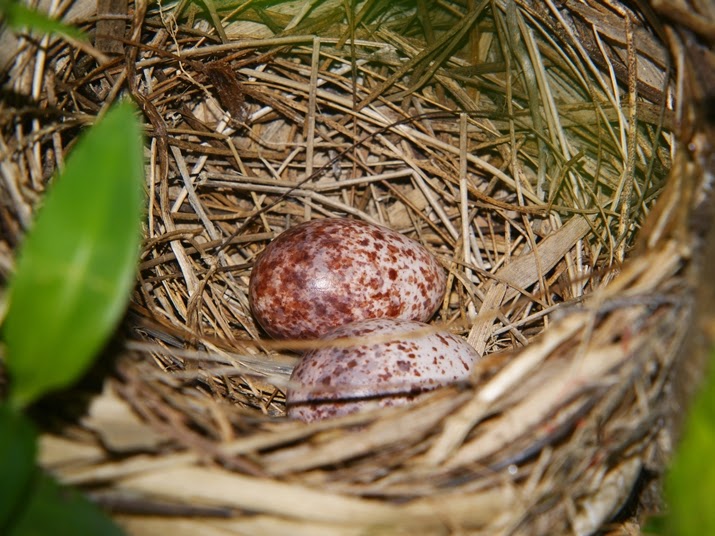
Yellow-bellied Prinia The Prinia is a slender warbler characterized by its long, graduated tail and thin bill, found across regions from Africa to Southeast Asia. In our area, the Yellow-bellied Prinia is among the most commonly encountered species, as it prefers open grasslands and agricultural areas which are usually close to human settlements. This bird is easily identified by its striking bright yellow underparts, which contrast with its olive-brown upperparts, whitish throat, and sometimes a small white speck in front of the eye. Its calls comprise of slurred whistling notes and a sort of mewing sound are often heard from within tall grasses, can help distinguish it from other warblers sharing the same habitat. It builds a purse-shaped nest made of thin plant fibers, attached to a grass stalk. Nest of Yellow-bellied Prinia In denser, well-wooded habitats such as forest edges and plantations, the Rufescent Prinia replaces the Yellow-bellied Prinia. Unlike its open country counterpa...

Black-thighed Falconet

Image
The sparrow-sized Black-thighed Falconet is one of the smallest raptor in this part of the world. It is identified by its very small size, black ear covert, and white underparts washed with rufous. Juvenile has white parts of the head strongly tinged with rufous.  Black-thighed Falconet on a stag. Because of its unobtrusive characteristics, it is usually overlooked by most people. Sometimes, especially from some distance away, it might be confused with a shrike , but the latter generally stays closer to the ground. Juvenile Black-thighed Falconet This tiny raptor favours forest clearings and survives well near human settlements with lots of trees such as villages and agricultural land. It sits and waits on exposed perch such as a dead tree, and sometimes on telephone pole or wire. From this vantage point, it scans around for its favourite food including dragonflies or butterflies which it usually catches on the wings. Related Post Types of Birds: Shri...

Types of Birds: Malkoha

Image
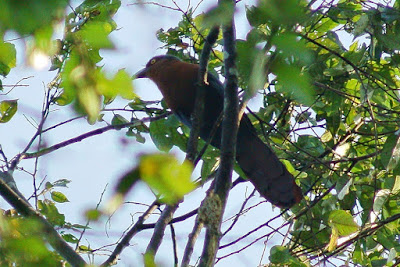
Unlike many cuckoos, the malkohas are not slender bodied nor do they have pointed wings. Instead, malkohas are relatively large birds ranging about 15 to 25 inches in length, with rounded wings and long graduated tail. They share the characteristics of cuckoos in having zygodactyl feet ; however, malkohas are not brood parasites, that is laying their eggs in the nest of other species of birds. Chestnut-breasted Malkoha primarily lives in the forest canopy. Only a few species of malkohas occurs here and most are restricted in this region. Chestnut-breasted Malkoha and Black-bellied Malkoha are among the commonest in the lowlands. Because of their cryptic nature and soft call which sounds like series of knocks, they are mostly overlooked. Yet, they are widespread in wooded areas including in plantations and villages where they may be seen gliding across rivers and rural roads. Black-bellied Malkoha has white tipped tail feathers. Raffles’s Malkoha, the smallest and t...

Gold-whiskered Barbet

Image
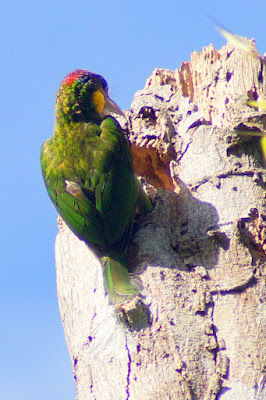
The Gold-whiskered Barbet is perhaps the most ubiquitous and among the largest barbet in the region, reaching almost 12 inches in length. It inhabits various kinds of wooded areas in the lowlands like primary and secondary forest, plantations and orchards. Like most barbets of the old world, this species is primarily green, with various colorful patches on its head. It owes its name to the large yellow patch on its cheek which can aid identification from a distance. Gold-whiskered Barbet excavating nesting hole. Barbets have zygodactyl feet, two toes point forward and the remaining two point backward--similar to the woodpeckers. This is anatomical adaptation is clearly useful for the Gold-whiskered Barbet to cling onto vertical surface during nest building. This species had been observed excavating it owns nest cavity using its strong bill as well as taking over the nest of woodpeckers. Gold-whiskered Barbet on a fruiting tree. Despite its large size, the Gold-whis...

Little Egret and Cattle Egret

Image
Little Egret ( Egretta garzetta ) is one of the smaller white egrets in this region, easily distinguished from other similar species by their relatively slender black bill and legs. It is almost always associated with waters, often seen waiting for prey in shallow waters, or wading and picking food off the water’s surface and occasionally dashes in pursuit of its prey. The Cattle Egret ( Bubulcus ibis ) appears similar, but it is stockier with yellow bill and tend to be found in dryland habitat as well as habitually perch on trees in large numbers.

Crow Pheasant or Greater Coucal

Image
This heavy cuckoo appears like a crow and regularly walks on the ground like a pheasant, which possibly the reason why it is called Crow Pheasant. Also known as Greater Coucal ( Centropus sinensis ), adult individuals are easily identified by its dual colored plumage with red eyes, and large size up to 20 inches in length.  Adult Crow Pheasant or Greater Coucal Crow Pheasant inhabits areas with tall grasses and dense scrub, like those found along rivers and at the edges of forest, cultivation and villages. Despite its common occurrence, it is seldom seen because it spends much time inside thick bushes and tall grasses. Early in the morning or after rain showers are probably the easiest period to view this bird as it preens and dries itself in open perches. Most of the time, it is often heard than seen because it has an unmistakable call consisting of a series of loud booming notes. Crow Pheasant's habitat typically consists of grassland with scattered trees and bush...

Types of Birds: Shrikes

Image
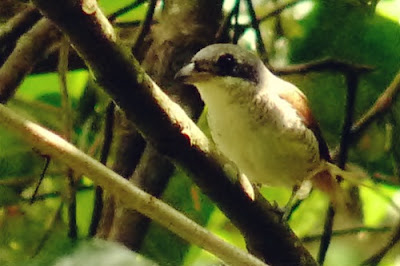
Only a few species of shrikes are found in this region, and almost all of them are winter migrants from the northern part of Asia. These passerines are also known as the butcher bird for their habit of impaling prey on thorn or barb wire.  Tiger Shrike Despite their small size, shrikes are well equipped with hooked-tip bill, and strong legs to capture relatively large prey. Most of the time, the migratory shrikes are seen catching large insects or small lizards, but they are capable of capturing smaller birds and mammals as well. Long-tailed Shrike Aside from the Brown Shrike, two other species are common migrants namely Tiger Shrike ( Lanius tigrinus) and Long–tailed Shrike ( L. schach ). The former derives its name from the prominent barring on its flank. Both tend to be found in contrasting habitat. Long-tailed Shrike favours open woodlands, with scattered tree and long grasses, whereas Tiger Shrike prefers denser habitat like forest edge, plantations and or...

Animal Pollinated Flowers

Image
Because pollination requires suitable pollinator to be successful, animal pollinated flowers have developed a variety of colors, scent and sizes; thus, restricting the kind of animals that visit them. Consequently, only animals with the right characteristics can feed on the nectar, and in return pollinate the flowers. A butterfly uses its proboscis to feed on nectar. Insects generally has keen sense of sight, hence they tend to visit colorful flowers. Butterflies, for example, often visit red, orange and yellow flowers, including those with long tubular tube for they can easily reach the nectar using their long sucking mouthparts .  In contrast, bees cannot see red but they can see blue. This explains why many bee flowers are blue or violet. Bees are attracted to blue, purple and violet flowers. Time of opening also played a crucial part in attracting the right pollinators. Some flowers open at night like those of durian , which are pollinated by bats. Strongly...

White-throated Kingfisher

Image
White-throated Kingfisher, aka White-breasted Kingfisher The White-throated Kingfisher ( Halcyon smyrnensis ) is also known as White-breasted Kingfisher because some populations have the white patch on its throat extend down to the breast. Typical of kingfishers, this bird has a large bill in comparison to its body size with short neck and legs. The bill is red in adults, but young individuals may have duller colored bill. In flight, the white patch on its wing is very conspicuous. White-throated Kingfisher habitually sits on open perch. A common bird in the region, this medium size kingfisher (~25cm) is one of those birds often seen around human habitation. It also inhabits open countryside, shrubs, ponds and rivers. One of the main reason for its adaptability is its variable diet that consist of insects, small reptiles like lizards and snakes, as well as fish. Unlike many species of kingfisher which dive into the water to catch fish, the White-throated kingfisher ...

Types of Bird Nest

Image
Cup type nest of Yellow-vented Bulbul. The most familiar type of bird nest to many people is the cup type, which looks like a shallow bowl, made of twigs and grasses. Feathers, mosses, and even human hair lined the inner side, presumably to facilitate incubation. The cup nest may be constructed from down low in the bushes as seen in some species of bulbuls, or high up on a forked branch like those of the Greater Racket- tailed Drongo.  Tree hole excavated by woodpecker. Instead of gathering and assembling materials for their nest, many birds excavate holes or burrows.  A prime example is the woodpeckers. Using their powerful chisel-like bill, and supported by their strong legs and tail, they habitually excavate nest in trees and stags. Bee-eaters and kingfishers favor steeps banks, usually near water, where they excavate burrows using their bill and clear away the soil with their feet. Not all hole nester excavate their own nest, for some species such as barb...

Types of Birds: Broadbills

Image
The Broadbills (Family Eurylaimidae) are generally colorful and stout bodied birds, with relatively broad and somewhat flattened bill. In the lowland rainforest of Southeast Asia, they mainly inhabit the middle and lower storey. Arthropods makes up a large portion of their diet, but some species like the Green Broadbill ( Calyptonema viridis ) also feed on fruits like those of Macaranga and  Ficus . Black and Red Broadbill Their nest is unique among rainforest birds in the region−a bulky globular structure made of various plant materials with a small chamber inside, suspended from a branch by plant fibers strong enough to support its weight. Black and Yellow Broadbill Broadbills are a type of “primitive” passerines, or also known as Suboscine because their syringes or vocal organs are much simpler than the other passerines, namely the Oscines. Nonetheless, they are quite vocal, and their voices are loud, attractive and can be use for identification.  The Bla...

Migrant Birds: Barn Swallow

Image
The Barn Swallow ( Hirundo rustica ) is one of many migrant birds in Southeast Asia.  Each year, Barn swallows migration takes place, during which the populations of the northern hemisphere will fly down south to spend the winter in Southeast Asia. Worthy of note that not all population of Barn swallows is migratory, for sedentary populations can be found elsewhere such as those in East-Mediterranean and Central Mexico. Barn Swallow A close relative of the Barn Swallow is the resident Pacific Swallow ( Hirundo tahitica ). It lacks the dark breast band and long tail streamers of the Barn Swallow. Pacific Swallow is a resident bird in Southeast Asia.

Egret or Heron

Image
Whilst a seasoned birder may not have difficulty in determining whether a bird is a heron or egret, a novice may find those two waterbirds confusable. Like pigeon and dove, heron and egret belong to the same family but their name are based on superficial appearance instead of on biological basis. Little Egret ( Egretta garzetta ) Generally, egrets are white in colour with black legs and they are comparatively smaller than herons. On the other hand, herons are much colourful birds and larger than egrets. Take a look at the pictures of Little Egret (above) and Purple Heron (below) because they nicely depicted the typical egret and heron features.  Purple Heron ( Ardea purpurea) Keep in mind, however, that some exceptions do occur; for example, a fairly small sized heron or an egret with a massive body size inhabits this region. Related Post Fishing Heron

Myna Birds

Image
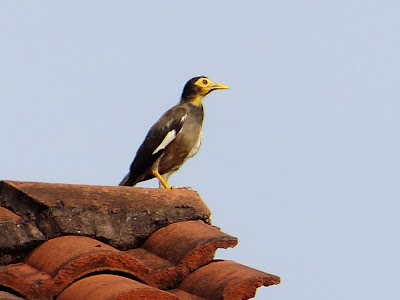
The Myna (also spelled Mynah) is a common urban bird in Southeast Asia. They are medium sized birds, mostly brown or grey plumaged with sharp yellow-orange bill. One of the most distinctive anatomical features is their relatively long legs which enable them to walk on the ground, unlike many passerines that find their way on the ground by hopping. Common Myna The Common Myna ( Acridotheres tristis ), also called Indian Mynah in other parts of the world is one of the most widespread species. It is omnivorous, taking not only insects on the ground, but also soft fruits like papaya . Another common species which is expanding its population throughout the region is the Javan Myna ( Acridotheres javanicus ). Plainer in appearance, it has a short crest at the base of the upper mandible and white patches under the wing. Javan Myna Myna can become a nuisance for people to the extent they are regarded as pest. In Singapore and Australia for example, large number of roosti...

The Call of Spotted Dove

Image
                The Spotted Dove, a popular pet bird, is noted for its melodious cooing song tu-koo-kurr .

Fishing Heron

Image
Like other herons, the Little Heron ( Butorides striatus ) has its own preferred fishing method. Most of the times it is observed waiting at the water‘s margin for potential food.  The Little Heron in the pictures below stood and waited on a partially submerged stalk in the middle of the pool. It used stealth and speed to catch an unsuspecting fish. The Little Heron waits for a fish to venture inside its striking distance The heron seizes its prey using its sharp harpoon-like bill The Little Heron successfully caught a small fish

Dollarbird

Image
Dollarbird habitually sits on high, exposed vantage point. Dollarbird ( Erystomus orientalis ) derived their name from the white patch on the underside of  the wing that resembles the silver dollar coin. In parts of Southeast Asia, they are known by what is literally translated into English as "Stone Myna", presumably due to their close resemblance to many mynas in the area - overall blackish with contrasting orange or yellow bill.  Dollarbird is also referred as the Oriental Roller. Indeed, Dollarbird belongs to the Roller Family (Coraciidae), which in turn gets its name from the birds rolling display flight. 

Types of Birds: The Doves

Image
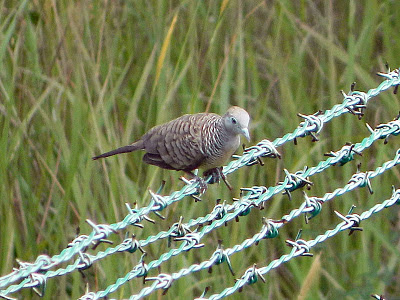
Peaceful Dove Spotted Dove Many different kinds of birds are found in Southeast Asia such as the  two species of doves shown in the above pictures. Taxonomically, the doves belong to the same family as pigeons - Columbidae, thus their close similarities. In general, the difference between doves and pigeons is that doves are slenderer with rather long graduated tails, and many have white outer tail feathers which are visible when the bird is taking off. The Spotted Dove and Peaceful Dove (also known as Zebra Dove) are popular pet birds because they have sweet cooing  call. In spite of being hunted and trapped, both dove bird are still commonly seen when birding in  open habitat like clearings, scrubby growth, parks and gardens. Their population seems to  thrive well partly  because such habitats  are expanding in the region due to development.

Labels

tropical fruit fruit hemiptera invasive species lizard spider Agamids animal camouflage arachnid butterfly camouflage mammals nest traditional medicine Lepidoptera adaptation antenna cuckoo insect camouflage insect mouthparts insect parts migrant birds moth poisonous plant predator reptile pictures snakes Cattle Egret Melastomataceae ants asssassin bug bird behaviour bird nest biting mouthparts cicada damselfly doves draco lizard egret flying dragon fungi ginger gliding lizards grasshopper heron hymenoptera insect adaptation invasive trees mangrove forest mangroves otter parasitoid proboscis rainforest plants shrike simple eyes sucking mouthparts vivipary wasp waterbird African Tulip Tree Ardea purpurea Asian fruits Asplenium Baya Weaver Beehive Ginger Bird's Nest Fern Black Bat Flower Black-naped Oriole Blattodea Bougainvillea Brown Shrike Butorides striatus Calotes versicolor Carica papaya Cat's Eye Fruit Cat's Whiskers Catclaw Mimosa Ceasarweed Centropus sinensis Cinnamon Bittern Clidemia hirta Colubridae Common Myna Congo Jute Coral swirl Dicranopteris linearis Dilleneaceae Dillenia Diptera Dollarbird Durians Durio zibethinus Dusky Langur Dusky Leaf Monkey Egretta garzetta Eurylaimidae Ficus Formicidae Garcinia mangostana Giant False Sensitive Mimosa Green Crested Lizard Ground Orchids Halcyon smyrnensis Hesperiidae Indian Rhododendron Indian mulberry Javan Myna Koster's Curse Lanius Lantana camara Little Egret Little Heron Macaranga tree Madagascar periwinkle Melastoma malabathricum Mimosa diplotricha Mimosa invisa Mimosa pigra Mimosa pudica Morinda citrifolia Nephelium lappaceum Odonates Oecophylla Orchidae Oriental Roller Plantain Squirrel Plumed Egret Pterophoridae Rafflesia Rambutan Rambutan tree Rosy periwinkle Rubiaceae Sensitive Plant Shrubby Simpoh Spathodea campanulata Spathoglottis plicata Stachytarpheta Striped Bronzeback Tacca chantrieri Urena lobata Varanus Water Hyacinth White-breasted Kingfisher White-breasted Waterhen White-throated Kingfisher Zingiber amphibians aphids aquatic plant banana flower banana musa barbet barn swallow bee bee flowers behaviour bird call bird foraging bird pollinated flowers bittern broadbills bufonidae bug bulbul bulbul pictures butcher bird castor bean castor oil caterpillar cauliflorous cauliflory chemoreception clavate antenna cockroach colubrid compound eyes costus speciosus crab spider crane fly cricket crow pheasant crypsis detrivore dove call dove song dragonfly ecdysis egret or heron epiphyte essential oil etlingera exoskeleton of an insect falconet fern fern plant ferns fiddler crab figs firefly fishtail palm flowerpecker fly frog gardening gastropod gerridae ginger flower greater coucal harvestmen hibiscus horticulture huntsman spider hydrophyte image of birds incomplete metamorphosis insect growth insect life cycle insect nymph insect vision introduced species jackfruit jacobson's organ jumping spider katydid kingfisher ladybug lampyridae langur larvae leafbird leafhopper leguminosae lilac long-tailed shrike longan lynx spider macaque malkoha malvaceae mango mango cultivars mangosteen mangrove ecosystem mangrove trees meliponines millipede mimicry molting molting lizard monitor lizard moulting process mudskipper mushroom mutualism nectar nephila non-venomous snake noni nonnative alien species nonnative species nonvenomous snakes nursery web spider nymph ocelli ommatidia orb weaver orb weaving spider orchid oriole orthoptera ovipositor painted bronzeback palms papaya papaya fruit parasitic plant passiflora passion flower passion vine pawpaw pectinate antenna pest pest birds pet birds pigeons pioneer species plant fiber plume pollination pollinators porterweed praying mantis preening primate prinia puddling pycnonotus rails rainforest lizard ranidae raptor red-tailed rat snake reduviidae resin robber fly root shrubs skinks skipper snail snakeweed spider web spores squirrel suboscines succession sunning symbiotic relationship tiger shrike toad tortoise beetle tree snake treehopper tropical rainforest urban birds venomous snake vipers water strider weaver ants weaver bird white white egrets wings wolf spider zingiberaceae zygodactyl feet
Show more