Posts

Showing posts with the label insects

Velvet Ant

Image
A female velvet ant . Velvet ants are not really ants, but rather a type of wasp of the order Hymenoptera which also includes bees and ants. Their velvety appearance comes from the tiny hairs covering their exoskeleton. The wingless females are colorful with yellow, orange or scarlet on their body, which serve as a warning to deter any potential predator. In addition, they also possess long stinger curled inside the abdomen that can deliver one of the most painful stings among insects. A close up view will reveal that they lack the "waist" or pedicel between the thorax and the abdomen, a key feature of ants. A parasitoid wasp , female velvet ants lay their eggs in the larvae or pre-pupa of other insects. The winged males are rarely seen, and are known to visits flowers, while the females are more likely to be spotted on the ground or among understorey shrubs.

Swallowtail Moth

Image
  Tropical Swallowtail Moth Among the most striking members of the swallowtail moth family (Uraniidae) is the Tropical Swallowtail Moth ( Lyssa zampa ). Its overall coloration is relatively subdued, but its impressive wingspan, which can reach up to 6 inch, makes it unmistakable. The prominent "tails" on its hindwings can also cause it to be confused with the swallowtail butterflies found in the same region. This nocturnal species is commonly encountered at rest, hanging upside down along forest trails during the day. It is also known for occasional mass emergence and is readily attracted to lights, sometimes even entering homes at night. Its larvae feed on trees of the genus Endospermum and other members of the Euphorbiaceae family, with pupation occurring among the leaf litter.  Acropteris swallowtail moth In contrast, swallowtail moths of the genus Acropteris are significantly smaller and brighter members of the family. Their delicate creamy-white wings are marked with ...

Assassin Bug Nymph

Image
Acanthaspis assassin bug nymph The nymph of some assassin bugs in this region employs a form of camouflage known as “ant piling.” For example, the nymph of  Acanthaspis sp. collects and carries multiple empty ant exoskeletons on its back as part of this disguise. Additionally, it first coats its upper body with layers of soil particles, dust and tiny plant debris using its hind legs. This behaviour distinguishes the Acanthaspis nymph from another assassin bug species, Inara flavopicta , which does not apply these layers of soil and sand, and whose backpack of ant carcasses appears noticeably cleaner. Beyond serving as visual protection from predators, this form of camouflage may also function as olfactory camouflage, helping to mask the nymph’s scent. Nymphs of the Acanthaspis assassin bug can be found in forested environments, on tree trunks and on the ground.

Swordtail and Swallowtail Butterfly

Image
  Five-bar Swordtail Both swordtail and swallowtail butterflies are grouped into the same family, namely  Papilionidae which is distinguished by the protrusions on their hindwings. In the case of swallowtails, these extensions often form twin tails reminiscent of a swallow’s forked tail. Swordtails, as their name implies, showcase a distinct, single sword-like extension which can clearly be seen in the Five-bar Swordtail ( Graphium antiphates ), for example.  It also differs from many swallowtail by their iridescent wings with green and yellow bands against a black background. Common Mormon Swallowtails such as the Common Mormon ( Papilio polytes ) has a somewhat broader wings, though they are not as quick as swordtails but still a strong flier.  Their wings are mainly black, with pale streaks visible up close on the forewings, while the hindwings have white streaks punctuated with red crescent markings. Interestingly, the female of this species exhibits a form of mi...

Cordyceps Fungi

Image
Cordyceps not only kills its host, but also brainwashes it to climb before dying. The humid and dense rainforest provides an ideal environment for parasitic fungi, such as those of the genus Cordyceps to thrive. These fungi primarily target insects, including ants, moths and their larvae. When a spore lands on a suitable insect host, it germinates and penetrates the exoskeleton of its unfortunate victim. Once inside, the fungus takes control of the host's nervous system, influencing it to seek an elevated position, such as the underside of a leaf in the lower canopy, rather than remaining on the forest floor. This behavior ensures more effective dispersal of the fungus's spores. Eventually, the fungal fruiting bodies emerge from the dead insect, as depicted in the photo.

Plume Moth

Image
Plume moth Plume Moths have distinctive features but may not be immediately recognizable as moths. Unlike most moths, their wings are not folded to the body or outstretched when resting. Instead, the wings are held at right angle forming a T shape. The wings compose of several feather-like structures which are not readily seen because they are rolled when the creature is at rest. This tiny Lepidopteran only reach around 10mm across and they are quite common, often spotted sitting on leaves with its body slightly turned upward. Plume moths are not known as a major pest for most plants, but in India they are regarded as pest to Pigeon Pea. The hairy caterpillars bore into pods and feed on the developing grain.

Stingless Bee

Image
A stingless bee collecting resin. Stingless bees are widely distributed in tropical regions, but they are most diverse in Southeast Asia partly due to the high numbers of resinous trees. They collect resins, such as those from dipterocarps trees in the rainforest, to be used as construction material for their nest which are built inside tree trunks. Resins also serve as protective material that deters predators including ants and wasps from attacking their colony. A stingless bee visiting Asystasia flower. Like honeybees, stingless bees feed primarily on nectar, but they are also known to opportunistically take honeydew, fruit juice, and carrion, among many others. When visiting tubular flowers, they habitually cut a hole near the base of the flower using their mandible, for easier access to nectar source. Locally, stingless bees are known as lukut (Philippines), kelulut (Malaysia) and emmu (Sulawesi). Locals have been rearing these social bees for honey usi...

Weaver Ants

Image
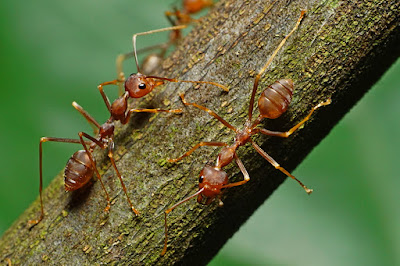
Ants construct their nest in a wide array of locations such as in soil, wood and trees. Weaver ants, unlike other tree dwelling ants, build a remarkable nest by "stitching" together leaves using silk from their larvae. Red weaver ants (Genus Oecophylla) Working as a team, workers pull and bend leaves using their strong mandible. Other workers carry larvae and then gently squeeze them with their jaw to secrete silk which will glue the leaves together. Occasionally a leave might be out of reach for a worker to grab. In such cases, several individuals will hold on to each other, forming a living bridge. Nest of the weaver ants. Weaver ants are beneficial to humans too. The larvae, also known as ant eggs because of their shape and whitish color, are eaten by people in Indo-China. Because weaver ants are very protective of their nest and will not hesitate to bite when disturbed, they are useful as a natural pest control. Indeed, farmers are known to deliberatel...

Leafhopper

Image
A leafhopper found in the rainforest. The leafhoppers are widely distributed around the world, inhabiting temperate as well as tropical region. Those living in Southeast Asia rainforest are easily recognizable because of their vibrant colors, distinctive body shape and behavior. In other parts of the world, these hemipterans are also called moth bug, due to their moth-like triangular wings. A leafhopper extracting sap from a plant. These insects are specialized sap feeders. Using their sucking mouthparts, they puncture a hole through the outer layer of plants before drinking the sap. Some species are regarded as pest because they might transfer virus during feeding. Most of them, however, are harmless creatures and make a fascinating subject for nature photography. A leafhopper nymph. The nymphs, the immature individuals in earlier stage of life, are unusually different from the colorful adults. Their body are fully covered with white fluffy wax which scientists b...

Crane Fly

Image
Crane fly is a member of the Tipulidae family. Despite its other name ‘mosquito hawk’, crane fly is not an oversized mosquito nor do it suck blood of humans and animals. It is a harmless flying insect, often spotted flying erratically and find its way inside homes as it is attracted to lights. Also known as daddy longlegs due to its resemblance to another type of invertebrate with slender long legs, crane flies do not feed at all or only drink nectar during adult stage. In contrast, its larvae feed on roots to the extent that it may damage crops, and some are known to prey on other insects.  Crane fly is also referred as mosquito hawk.

Tortoise Beetle

Image
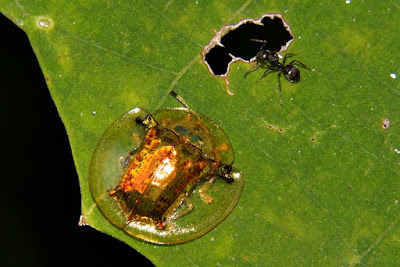
Tortoise Beetle The Tortoise Beetle generally is golden in color, but when disturbed it can change color rapidly—very much like a chameleon. It can pull its legs and antenna under the flattened dome on top of its body like a tortoise, rendering itself inaccessible to predators. This remarkable color change is believed due to changes in moisture content of the cuticle, the outer layer of the insect body. Tortoise Beetle can change color rapidly. As the pictures shows, the outer cuticle becomes transparent, revealing the underlying layer which is orange spotted with black, mimicking a ladybug which is unpalatable to most predators. Although it looks like a ladybug, this herbivorous beetle belongs to its own family, Cassidinae . A ladybug resembles a Tortoise Beetle with is black-spotted cuticle.

Robber Fly

Image
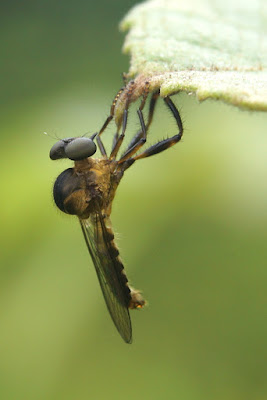
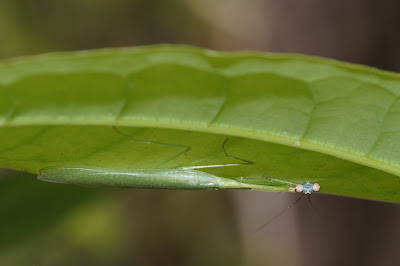
A robber fly hanging underneath a leave. Robber Fly (Family Asilidae) shares many characteristics of its close relative, the House Fly (Family Muscidae), but the former can be distinguished by its enlarged thorax and elongated abdomen. This predatory insect relies on sight, swiftness and surprise to catch insects mostly on the wings. It uses its spiky legs to grasp its prey before sucking it dry using its short proboscis, leaving behind only an empty casing. Robber fly preying on a leaf hopper. These flies are quite common in wooded areas, where they are often seen sitting on exposed twigs or hanging upside down on the tip of a leave, ready to ambush any potential prey. They come in varying color from blackish to grey and even bright green. It is a ferocious hunter in the insect kingdom, capable of preying on other insects much larger than itself like dragonflies, bees and wasps. Related Post Crane Fly

Moth in Camouflage

Image
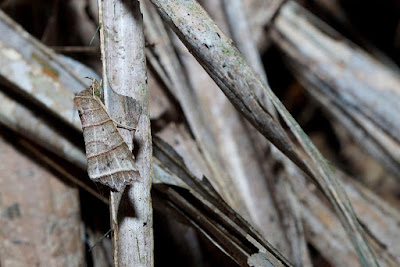
A moth in camouflage among the dead palm fronds. Camouflage or crypsis is crucial for the survival of insects like moths whose predators rely much on sight when hunting. As such many species of moths in the rainforest have coloration and pattern that resemble the surrounding on which they settle. In addition, some species behave in a particular way to optimize their camouflage. For example, the moth in the picture not only has the same coloration as the dead palm fronds, but it also adopts a position which makes its horn-like appendage appear like the thorn on the frond.

Animal Camouflage: Praying Mantis

Image
A praying mantis in camouflage. Predatory insect like the praying mantis also relies on camouflage to catch its prey. Their colors and venation can almost perfectly match leaves, twigs and even flowers, rendering themselves difficult to discern among the vegetation. Related Post Insect Camouflage: Grasshopper

Assassin Bug

Image
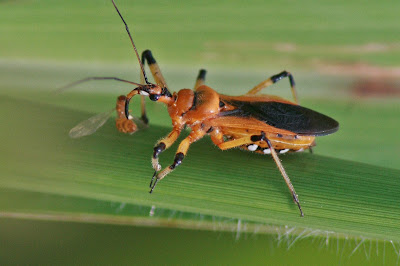
Assassin bugs (Family Heteroptera) are aptly named because they are predatory insects, feeding mainly on other insects. This hemipteran of the order Reduviidae has a relatively small and longish head with large compound eyes and a distinct sucking mouthparts. Their legs are fairly large and they effectively use it to grasp their prey. They puncture their victim with their elongated mouthparts and inject poisonous saliva which will dissolves tissues, before eventually suck their prey body fluid. Assassin bug with prey. Interestingly, assassin bugs are known to use chemical bait to catch their prey. Some species collect plant sap on their leg that attract other insects. Others secrete chemical that not only attract ants but also kill them. And one species spits poisonous chemical to paralyze its prey. Assassin bug uses its long mouthparts to feed on other insects. Except for those species that cause Chagas disease in South America, assassin bugs are not harmful to ma...

Animal Pollinated Flowers

Image
Because pollination requires suitable pollinator to be successful, animal pollinated flowers have developed a variety of colors, scent and sizes; thus, restricting the kind of animals that visit them. Consequently, only animals with the right characteristics can feed on the nectar, and in return pollinate the flowers. A butterfly uses its proboscis to feed on nectar. Insects generally has keen sense of sight, hence they tend to visit colorful flowers. Butterflies, for example, often visit red, orange and yellow flowers, including those with long tubular tube for they can easily reach the nectar using their long sucking mouthparts .  In contrast, bees cannot see red but they can see blue. This explains why many bee flowers are blue or violet. Bees are attracted to blue, purple and violet flowers. Time of opening also played a crucial part in attracting the right pollinators. Some flowers open at night like those of durian , which are pollinated by bats. Strongly...

Compound Eyes of Insects

Image
Compound eyes consist of numerous ommatidia. Most insects have compound eyes, which upon closer inspection have many an array tiny lenses. They are the most visible part of the subunits of the compound eyes known as ommatidia. Each ommatidium comprises of the lens, light gathering unit and light absorbing cells. A dragonfly's compound eyes can have thousands of ommatidia. Because the lens is not flexible like ours, an insect cannot focus properly resulting in less detailed view of their surroundings. However, an insect vision is very efficient when it comes to detecting movement. As an object moves across their field of vision, it turns each corresponding ommatidia on and off making them highly sensitive to movement. This adaptation of the insect eyes is important because it helps insects evade predators, hunt potential prey and avoid collision when flying. Compound eyes help this fly catches its prey. The numbers of ommatidia varies among insects. General...

Water Striders

Image
In the rainforest, water strider, which belongs to the family Gerridae in the order Hemiptera , inhabits damp habitat like streams especially near the banks. Most water striders are large insects with elongated body, long and slender legs, and large eyes visible up close. The middle legs mainly help the water strider move on the water surface and the front ones are use to handle prey. A water strider can "walk " on water. Aside from visual cues, water strider or also known as water skater, detects prey in the water via vibration. It feeds on its prey tissues fluid using piercing-sucking mouthparts with the help of strong digestive enzyme. However, water striders are themselves food for other animals like fishes, birds and frogs. For this reason, they have drab coloration that helps them avoid predators. Rainforest streams are suitable habitat for water striders. Scientists have long known that water tension partly explains how water striders walk on water. How...

Ants and Aphids

Image
A close association between two organisms of different species, also called symbiosis, is not rare in nature. In some of these cases, the relationship is beneficial to both organism involved. Biologists use the term mutualism to describe such symbiotic relationship. An example of mutualism is between ants and aphids. An ant tending aphids for honeydew. Aphids (order Hemiptera) are phloem-feeding insects that secrete honeydew as a by-product of feeding on large amount of plant sap. Many species of ants will herd aphids to obtain constant source of this sugary substance, which is not only rich in carbohydrate but also minerals and amino acids. An ant often strokes the aphid that it comes across with its antenna, a behavior believed to hold back the aphid fleeing response. Rather than escaping, the aphid lifts its abdomen and secretes the honeydew. In return, the ant confers protection to the aphid from parasites and predators. Some treehoppers also form symbiotic relatio...

Cockroach

Image
Many people associate cockroach, an insect of the order Blattodea, with black and brown color, but a number of species can be quite colourful with orange, white and red markings. When it comes to body size, cockroach shows a range of size from the typical small species often seen in the kitchen or garbage dump, to larger species that can reach 3 inches in length like the Madagascar Giant Hissing Cockroach.  Cockroach can be quite colourful. Cockroach eggs are stored in a waterproof pod, which is white as it started to come out from the female body but turns into black once it is deposited. Because cockroaches undergo incomplete metamorphosis, young individuals that just hatch appear like the adult, similar to some other insects such as grasshopper and cricket , for example. A cockroach on Metastoma malabathricum flower. Do cockroach bite? They do have biting mouthparts but they rarely bite human, unless in large-scale infestation where they may bite skins and n...

Labels

tropical fruit fruit hemiptera invasive species lizard spider Agamids animal camouflage arachnid butterfly camouflage mammals nest traditional medicine Lepidoptera adaptation antenna cuckoo insect camouflage insect mouthparts insect parts migrant birds moth poisonous plant predator reptile pictures snakes Cattle Egret Melastomataceae ants asssassin bug bird behaviour bird nest biting mouthparts cicada damselfly doves draco lizard egret flying dragon fungi ginger gliding lizards grasshopper heron hymenoptera insect adaptation invasive trees mangrove forest mangroves otter parasitoid proboscis rainforest plants shrike simple eyes sucking mouthparts vivipary wasp waterbird African Tulip Tree Ardea purpurea Asian fruits Asplenium Baya Weaver Beehive Ginger Bird's Nest Fern Black Bat Flower Black-naped Oriole Blattodea Bougainvillea Brown Shrike Butorides striatus Calotes versicolor Carica papaya Cat's Eye Fruit Cat's Whiskers Catclaw Mimosa Ceasarweed Centropus sinensis Cinnamon Bittern Clidemia hirta Colubridae Common Myna Congo Jute Coral swirl Dicranopteris linearis Dilleneaceae Dillenia Diptera Dollarbird Durians Durio zibethinus Dusky Langur Dusky Leaf Monkey Egretta garzetta Eurylaimidae Ficus Formicidae Garcinia mangostana Giant False Sensitive Mimosa Green Crested Lizard Ground Orchids Halcyon smyrnensis Hesperiidae Indian Rhododendron Indian mulberry Javan Myna Koster's Curse Lanius Lantana camara Little Egret Little Heron Macaranga tree Madagascar periwinkle Melastoma malabathricum Mimosa diplotricha Mimosa invisa Mimosa pigra Mimosa pudica Morinda citrifolia Nephelium lappaceum Odonates Oecophylla Orchidae Oriental Roller Plantain Squirrel Plumed Egret Pterophoridae Rafflesia Rambutan Rambutan tree Rosy periwinkle Rubiaceae Sensitive Plant Shrubby Simpoh Spathodea campanulata Spathoglottis plicata Stachytarpheta Striped Bronzeback Tacca chantrieri Urena lobata Varanus Water Hyacinth White-breasted Kingfisher White-breasted Waterhen White-throated Kingfisher Zingiber amphibians aphids aquatic plant banana flower banana musa barbet barn swallow bee bee flowers behaviour bird call bird foraging bird pollinated flowers bittern broadbills bufonidae bug bulbul bulbul pictures butcher bird castor bean castor oil caterpillar cauliflorous cauliflory chemoreception clavate antenna cockroach colubrid compound eyes costus speciosus crab spider crane fly cricket crow pheasant crypsis detrivore dove call dove song dragonfly ecdysis egret or heron epiphyte essential oil etlingera exoskeleton of an insect falconet fern fern plant ferns fiddler crab figs firefly fishtail palm flowerpecker fly frog gardening gastropod gerridae ginger flower greater coucal harvestmen hibiscus horticulture huntsman spider hydrophyte image of birds incomplete metamorphosis insect growth insect life cycle insect nymph insect vision introduced species jackfruit jacobson's organ jumping spider katydid kingfisher ladybug lampyridae langur larvae leafbird leafhopper leguminosae lilac long-tailed shrike longan lynx spider macaque malkoha malvaceae mango mango cultivars mangosteen mangrove ecosystem mangrove trees meliponines millipede mimicry molting molting lizard monitor lizard moulting process mudskipper mushroom mutualism nectar nephila non-venomous snake noni nonnative alien species nonnative species nonvenomous snakes nursery web spider nymph ocelli ommatidia orb weaver orb weaving spider orchid oriole orthoptera ovipositor painted bronzeback palms papaya papaya fruit parasitic plant passiflora passion flower passion vine pawpaw pectinate antenna pest pest birds pet birds pigeons pioneer species plant fiber plume pollination pollinators porterweed praying mantis preening primate prinia puddling pycnonotus rails rainforest lizard ranidae raptor red-tailed rat snake reduviidae resin robber fly root shrubs skinks skipper snail snakeweed spider web spores squirrel suboscines succession sunning symbiotic relationship tiger shrike toad tortoise beetle tree snake treehopper tropical rainforest urban birds venomous snake vipers water strider weaver ants weaver bird white white egrets wings wolf spider zingiberaceae zygodactyl feet
Show more